Deposit £5 Get 200 Free Spins: the Bundle, Chalked
A fiver buys two hundred spins, delivered in tranches on a schedule. Weigh the daily tranche, the clock on each, and the wagering behind the winnings.
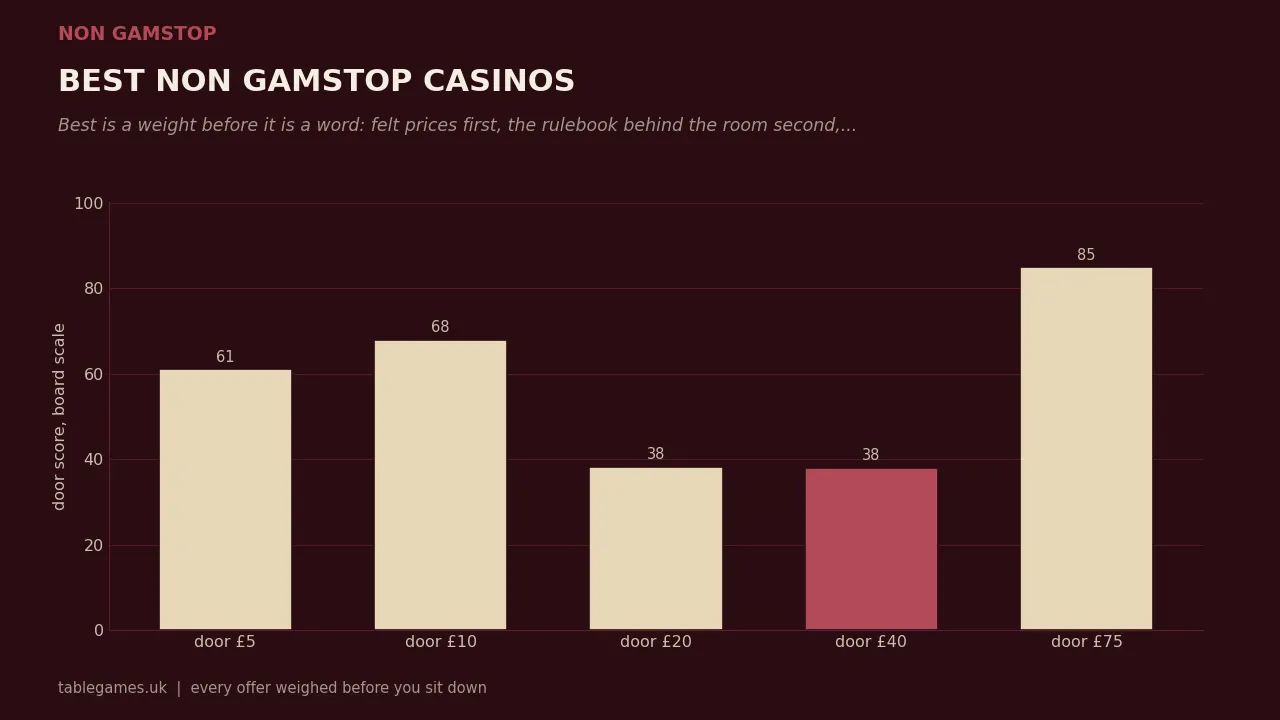
The table score
Four operators, weighed the way a croupier weighs a table: the entry price, the terms weight, the rails on offer, and how fast the cage pays. The scores are ours; the offers are quoted in the operator's own words.
Every card carries its table score out of 10 and four axis bars - licence, terms, payments and withdrawal. Offers move often - the operator's own page is always the current truth.

Welcome bonus €/£5,000 + 500 FS
Weigh the offer
Welcome pack €5,000 + 500 FS + €650 free bet
Weigh the offer
Casino welcome bonus 805% up to €6,400 + 280 FS
Weigh the offer
Welcome package 300% up to €/£1,000 + 150 FS
Weigh the offerCards appear in table-score order, the lower minimum deposit breaking ties. The bars visualise published figures, not a promise; nothing here is a recommendation to gamble, and the operator's own terms decide every claim.
What a fiver buys: the bundle at face value
Two hundred spins against a £5 deposit is a bundle priced in pence. The per-spin print at this size commonly sits at 10p or just below, and two hundred rounds at 10p chalk £20.00 of face value - four times the money that triggered them, which is why the headline sells. The face figure is not a payment; it is the amount the spins will stake, and what comes back depends on the game's long-run price and on how much of the bundle the schedule actually delivers.
The schedule is the part the headline never mentions. Bundles of this size rarely land at once: they arrive in daily tranches, twenty a day for ten days being a common shape, and each tranche is live for its own window before it lapses. The offer's true size is therefore a diary figure - the headline multiplied by the days the player attends - and attendance is knowable in advance, which makes it the first figure to chalk rather than the last.
This page weighs the bundle in the order the money meets it: the fiver that triggers it, the tranche and its window, the face value the stake box sets, the wagering behind whatever the spins win, and the felt where the deposit itself plays once the bundle is spent. The order matters because each number feeds the next, and the last one - the fiver at the tables - is the part of the offer the banner never prices at all.
The schedule: twenty a day across ten days
Chalked day by day, the schedule reads: twenty spins land, live for the window the terms set - commonly a day or three - and worth £2.00 of staked distance at a 10p print. Ten attended days build the full £20.00; each unattended day lapses its £2.00 silently. On a game commonly quoted in the mid-nineties for long-run return, a full run stakes £20.00 and expects about £19.00 back, which leaves the house's keep at a pound across the whole bundle and about 10p a day.
Attendance is the multiplier on all of it. Eight days attended stakes £16.00 and expects £15.20 back; five days stakes £10.00 and expects £9.50. The lapses are not announced - the schedule simply carries on without that day - so the tally survives only in the player's own record. A player who knows they visit twice a week should price the bundle at four or five tranches, £8.00 to £10.00 of face value, and treat the headline as the offer's ceiling rather than its price.
The window on each tranche deserves the same chalk as its size. A tranche that lapses after twenty-four hours suits a daily habit and taxes a weekend one; a seventy-two-hour window forgives a missed day without returning the schedule to zero. The window prints in the terms beside the tranche size, and the pair of them set the offer's real shape. a smaller bundle on its own card runs fewer spins through the same schedule arithmetic, and the pattern holds at every size: tranche, window, attendance.
Deposit 5 get 200 free spins at a glance
- Entry price£10 typical
- Wagering45x on spin winnings
- Payout window2–4 working days
- Payments3 rails incl. e-wallet
The stake box and the ceiling on the winnings
The stake box on the spins is the room's to set, and it moves the face value more than any other line. At 10p a spin the bundle stakes £20.00; at 5p it stakes £10.00 under an identical two-hundred headline; at 2p, £4.00. The per-spin print is fixed - the player cannot size the rounds up - so the box is worth reading before the claim, in the terms line that names the stake and the games the spins run on.
Whatever the spins win usually carries a wagering line before it becomes withdrawable, and sometimes a cap on what it may release. The multiplier on spin winnings commonly runs in the thirties or forties on this class, and the cap prints beside it. Weighed against the expected £19.00 of return across a full run, a cap sits either far enough above the tally to be scenery or close enough to trim it - which is a two-minute read of the terms block that decides the difference.
The games under the bundle move the expected figure too. Rooms swap titles on scheduled offers, and a point of long-run payout on the underlying game moves the return by roughly 20p across a full £20.00 run - small daily, real across ten days. The game's own info screen carries the long-run figure, and it is the honest source where the terms name only a title. Hedge the specifics, chalk the direction, and price the bundle from the print rather than the promise.
Wagering the winnings: the second clock
Spin winnings rarely arrive as cash. They land as bonus credit with a multiplier of its own, commonly in the thirties or forties, and a second clock - the wagering period - runs against it. Worked at the numbers this page uses: £2.00 of winnings across a full run, at forty times, books £80 of counted distance before the credit converts. On slots at full weighting that is eighty rounds at a £1 stake; on tables at the tenth weighting many terms allow, it asks £800 of felt stakes.
The second clock is where bundles of this class differ most, and where the terms reward a slow read. Some offers run the winnings with no multiplier at all, converting as they land; some carry the full forty-times line; a few cap the conversion regardless. The difference between the readings is the difference between a bundle that pays its keep and one that spins and nothing more. that same bundle without the clock prices the no-wagering version of this headline against a larger deposit, and the contrast is the clearest single way to see what the multiplier costs.
Table players should say the weighting before planning any clearing route through the winnings. A tenth weighting turns £80 of counting into £800 of stakes; a zero turns the felt into scenery; and the maximum stake box on credit - commonly £2 to £5 a round - voids the credit where a round exceeds it. The winnings from a £5 bundle are small enough to walk honestly on the machines and awkward to walk at the felt, which is a fact of the weighting, not of the bundle.
| Brand | Welcome offer | Wagering | Min dep. | Withdrawal | Payments | Licence | Table score | Terms |
|---|---|---|---|---|---|---|---|---|
| PlayOJO | 50–100 wager-free spins (typical range) | Wager-free spins marketed | £10–£20best | 1–2 working days+2d | Visa · Mastercard · Neteller · Pay by mobile-1 rails | UKGC | 7.9 / 10 | Check the terms first |
| BetWright | 100% up to £/€100 + spins (typical) | 30x–40x by productbest | £10best | 24h e-wallets, 2–5 days cards+5d | Visa · Mastercard · PayPal · Apple Pay-1 rails | UKGC | 7.7 / 10 | Check the terms first |
| BetVictor | 100% up to £/€100 + spins (typical) | 35x typical+5x | £10best | 24h e-wallets, 2–5 days cards+5d | Visa · Mastercard · PayPal · Apple Pay-1 rails | UKGC | 7.4 / 10 | Check the terms first |
| Velobet | 100% up to €/£1,000 + spins (typical range) | 30x–45x by gamebest | €10 equivalentbest | Instant–24h on cryptobest | Bitcoin · Litecoin · Visa · Bank transfer-1 rails | Offshore | 6.8 / 10 | Check the terms first |
| JackpotCity | 100% up to €/£100 + 50 spins (typical) | 30x typicalbest | €10–€20best | 2–5 working days+5d | Visa · Mastercard · Trustly · Bank transfer-1 rails | Offshore | 5.9 / 10 | Check the terms first |
| LottoGo | Free bets / credits on first ticket (typical) | 40x on bonus funds+10x | £10best | 24–48h e-wallets+48d | Visa · Mastercard · Neteller · Pay by mobile-1 rails | UKGC | 5.9 / 10 | Check the terms first |
| 10bet | 100% up to €200 + spins (typical range) | 40x typical+10x | €20+10 | 1–3 working days+3d | Visa · Mastercard · Skrill · Neteller-1 rails | Offshore | 5.7 / 10 | Check the terms first |
| Magic Red | 100% up to €200 + spins (typical range) | 40x typical+10x | €10–€20best | 2–5 working days+5d | Visa · Mastercard · Trustly · Bank transfer-1 rails | Offshore | 5.2 / 10 | Check the terms first |
| Mystake | 100% up to €/£1,000 + spins (typical range) | 35x typical+5x | €20 equivalent+10 | Under 24h on crypto+24d | USDT · BTC · ETH · TRX · Visabest | Offshore | 4.9 / 10 | Check the terms first |
| Boneenbet | 100% up to €/£1,000 + spins (typical range) | 35x typical+5x | €10 equivalentbest | 24–48h (crypto fastest)+48d | Bitcoin · Litecoin · Visa · Bank transfer-1 rails | Offshore | 4.5 / 10 | Check the terms first |
| Roobet | Matched deposit up to €/£500 + spins (typical) | 35x typical+5x | €10 equivalentbest | Under 24h on crypto+24d | BTC · ETH · USDT · MuchBetter-1 rails | Offshore | 4.5 / 10 | Check the terms first |
| Donbet | Matched deposit up to €/£500 + spins (typical) | 40x typical+10x | €10 equivalentbest | 24–48h (crypto fastest)+48d | Bitcoin · USDT · Visa · Mastercard-1 rails | Offshore | 4.1 / 10 | Check the terms first |
The fiver itself at the tables
The deposit behind the bundle has its own price, and the felt is where it plays without strings. £5 on a single-zero wheel expects 13.5p to the house per spin, the wheel's 2.70 per cent take; the same £5 at a sound blackjack table expects about 2.5p a hand at the half-point fraction; banker baccarat at 5 per cent commission takes about 5.3p a hand. The fractions repeat every round whatever the balance, so the fiver plays the same game on the same prices a far larger balance would face.
Weighed in rounds, the fiver buys a bounded stretch of felt. Live minimums commonly run from 50p upward, which makes it ten or fewer spins on the cheaper wheels; random-number minimums often sit from 10p to £1, where it stretches into dozens or hundreds of rounds. The bundle and the deposit run on different clocks - the tranche on its daily window, the balance on the player's own evening - and the two together are what the £5 actually buys.
There is also the quiet case for playing the deposit and ignoring the bundle: a fiver at the printed prices owes nothing to any counting line, converts nothing at the cage and forfeits nothing to a missed window. Where the schedule does not fit the diary, that route is the honest floor price of the offer. The bundle is the upside; the fiver at the felt is the certainty; and the two are priced separately by every term on the page.
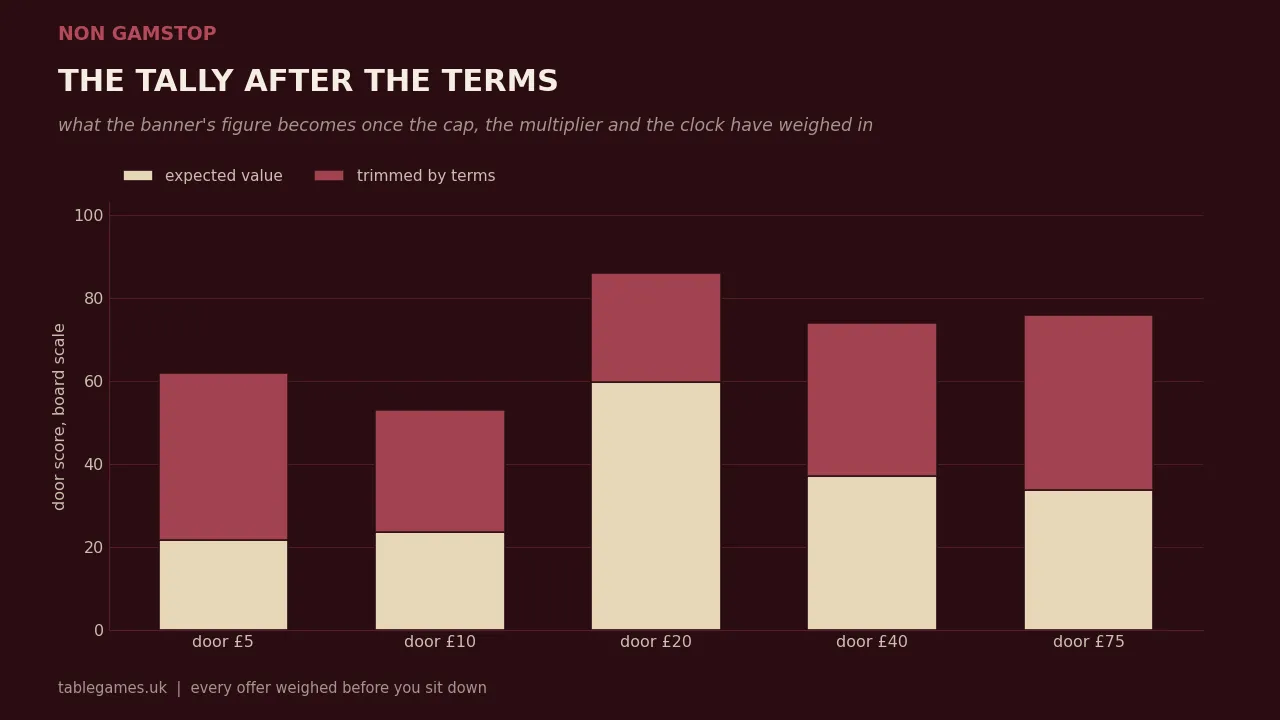
Eligibility, rails and reading the offer before the claim
Eligibility at this door is penny-strict: the trigger reads £5.00, so £4.99 books nothing and the bundle never lights. The triggering deposit also has to arrive on a rail the terms admit, because some offers exclude named e-wallets or prepaid vouchers from spin bundles entirely. Debit cards are the default admission at most rooms, and the cashier's fee table prices the arrival: a 30p flat charge on a fee-carrying rail takes six per cent of a fiver, while cards commonly charge nothing at this size.
One rulebook line belongs on this card, kept to a sentence. Rooms that price spin bundles at a fiver are commonly licensed offshore rather than in Britain, which decides who answers a complaint about a lapsed tranche, and leaves the printed terms exactly as they read. The practical read is unchanged: the trigger figure, the tranche window, the per-spin stake, the wagering on the winnings, any cap - all of it in the offer's terms block, all readable before the deposit moves.
The claim itself is the last check. Bundles at this size usually require the spins to be claimed or started inside the first window, and an unclaimed first tranche commonly lapses with the rest to follow. The honest sequence is: deposit on an admitted rail, claim inside the window, play each tranche inside its own, and keep the tally in the player's own record, because the schedule keeps none. Five minutes of reading prices the whole offer; the lapses price it again silently.
The weigh card: the bundle in four lines
Four lines price a deposit-£5-get-200-spins offer, each one readable from the terms in minutes. The tranche and its window. The per-spin stake and the face value it sets. The wagering and any cap on the winnings. And the felt price of the fiver itself, which plays at the printed edges regardless of the bundle. Chalked in that order, the card converts a headline into a figure the diary can actually collect.
The bundle, chalked in order:
- trigger: £5.00 exact on an admitted rail, with cards commonly free and fee rails taking their share
- tranche: twenty spins a day across ten days, staking £2.00 a day at the 10p print
- window: each tranche live for its own day or three, lapsing silently when missed
- winnings: about £19.00 expected across a full run at a mid-nineties game, before any cap trims
- wagering: commonly thirties or forties on winnings - £2.00 at forty times books £80 of counted distance
- felt: the fiver expects 13.5p a spin on a single-zero wheel and 2.5p a hand at sound blackjack
run together, the four lines say what the offer is: four times the deposit in staked distance, delivered ten days at a time, with the winnings' price set by the multiplier and the cap rather than by the headline. A diary that attends daily collects the full shape; a weekend diary collects a fraction and pays the same attention price. The card is the difference between pricing the bundle in advance and discovering it a lapsed tranche at a time.
The bundle is honest at its best price. Twenty pounds of spins for a fiver, walked on the machines at the game's own long-run figure, is a fair shape for a small deposit, and the schedule even paces it sensibly. What the headline cannot promise is attendance, and what the terms decide is everything else: stake, window, multiplier, cap. Chalk the card before the claim and the offer is priced; skip the card and the schedule prices it anyway, in lapses.
Frequently asked questions
How are the 200 spins delivered?
Commonly in daily tranches - twenty a day across ten days is a frequent shape - with each tranche live for its own window before it lapses. The split and the window are each room's own, so the terms line naming both is the honest source. The figure to price the offer from is the tranche multiplied by the days the diary will actually attend, not the headline.
What are the spins worth?
At the 10p print common at this size, the full bundle stakes £20.00 and a game returning in the mid-nineties over the extended run expects about £19.00 back across it. At 5p the same headline stakes £10.00, and at 2p, £4.00. The per-spin stake is fixed by the room, so the terms line naming it moves the offer's value more than the headline does.
What happens to spin winnings?
They commonly land as bonus credit with a wagering multiplier attached - thirties or forties on this class - and sometimes a cap on what may convert. At £2.00 of winnings and forty times, the counted distance is £80, walked at full weighting on slots and at a tenth on tables where the terms allow the felt anything. Some offers run no multiplier at all, converting winnings as they land.
Can the deposit be withdrawn without playing the bundle?
The deposit cash follows the room's ordinary rules, but claiming the bundle usually binds the balance to its terms: wagering on the winnings, a maximum stake box and forfeiture of the credit on an early withdrawal request are common prints. The honest alternative, where the schedule does not fit, is to decline the bundle and play the fiver at the printed prices, where nothing is owed to a counting line.
Do tables clear the wagering on spin winnings?
Only where the terms give the felt a share, and on this class the share runs from a tenth down to nothing, live tables the most frequent exclusion. A tenth turns £80 of counting into £800 of felt stakes, which is an evening's arithmetic the maximum stake box then paces. The weights print game by game in the terms, and they are read before planning a clearing route, not after.
Who suits this offer?
A player with a daily habit, because attendance is the figure the schedule trades on: ten attended days collect the full £20.00 of staked distance, while a twice-a-week diary collects a fraction of the headline. A table player should read the weighting first, since the bundle is a slot offer in every case that matters. Anyone without the routine should price the lapses honestly before the claim.