Ethereum Casino: the Stake in Two Units, Weighed
An ether balance and a pound stake box keep two different clocks. Weigh the quote, the network fee, the felt's own edges and the licence.
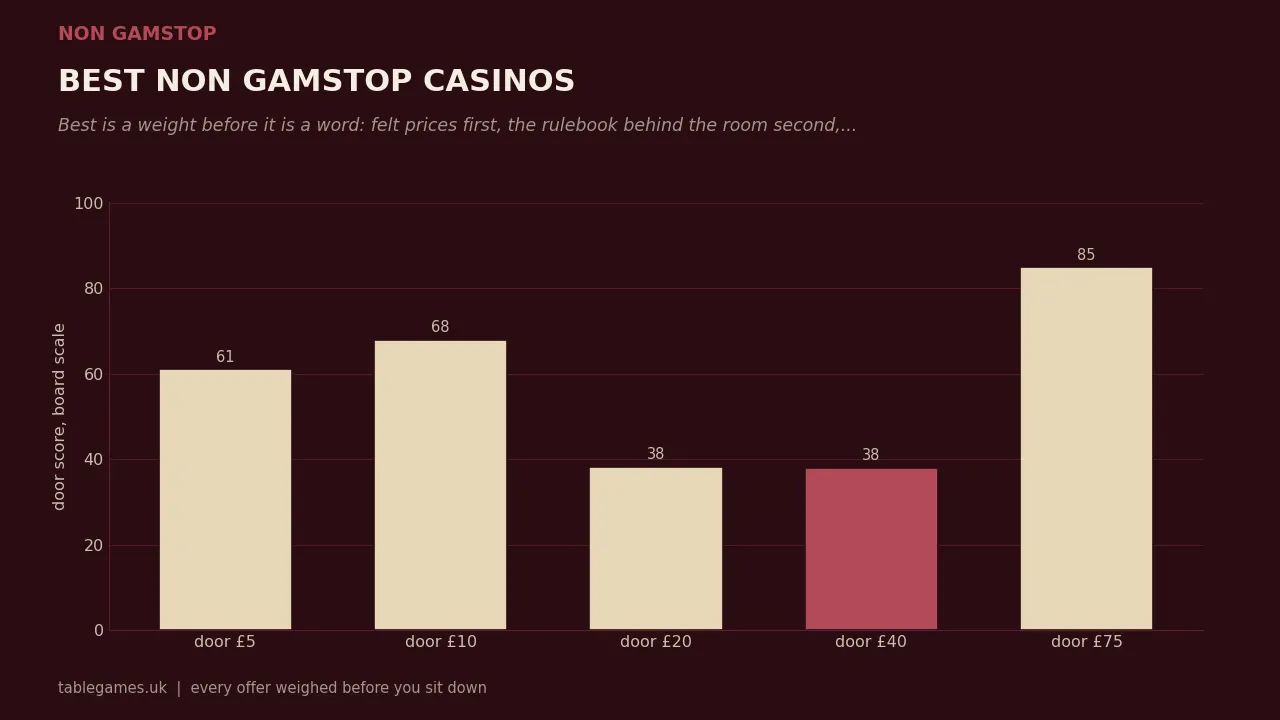
The table score
Four operators, weighed the way a croupier weighs a table: the entry price, the terms weight, the rails on offer, and how fast the cage pays. The scores are ours; the offers are quoted in the operator's own words.
Every card carries its table score out of 10 and four axis bars - licence, terms, payments and withdrawal. Offers move often - the operator's own page is always the current truth.

Welcome bonus €/£5,000 + 500 FS
Weigh the offer
Welcome pack €5,000 + 500 FS + €650 free bet
Weigh the offer
Casino welcome bonus 805% up to €6,400 + 280 FS
Weigh the offer
Welcome package 300% up to €/£1,000 + 150 FS
Weigh the offerCards appear in table-score order, the lower minimum deposit breaking ties. The bars visualise published figures, not a promise; nothing here is a recommendation to gamble, and the operator's own terms decide every claim.
What does an ethereum casino change about the stake?
The stake itself changes address, not size. A table posts its minimums and its prices in pounds; an ethereum balance counts in coin; and every round debits the posted figure while the balance underneath is priced by a market that never closes. A £2 stake is a £2 stake at the moment it is placed, whichever asset carried the money to the table - and the unit question reopens the moment the round ends and the balance is re-priced. Two units, one receipt, and the receipt is where this page does its weighing.
So the weighing splits in two. The felt keeps its own card - pocket counts, natural prices, commissions - and none of it moves for the rail. The receipt around the felt gains lines a card-funded session never carries: the quote at purchase, the network fee at transfer, the quote at sale, and the licence that decides where a dispute runs. This page takes the receipt lines in the order they bite, and leaves the felt's figures to the tables' own panels, where they were posted long before anyone arrived with a wallet.
The order matters because the receipt lines are fixed at different moments. The quote and the fee are fixed before the first stake; the balance's value moves throughout; the licence is settled - or not - before any of it. A player who chalks all three before depositing has priced the session; a player who chalks none has rented it, and the landlord sets the terms session by session.
The unit of stake: pounds posted, coin carried
Work the two units on a £240 float. Bought at the door, the pounds become a fixed quantity of ether at that moment's quote; if the quote slips 2 per cent before the session starts, the float's stake value is £235.20 and the missing £4.80 never reached a table. The stake box still debited £2 a round exactly as posted - the swing lives entirely in the unit the balance is counted in, and it arrives whether or not the player was watching the ticker.
The two-unit structure also explains what the stake box does not show. A posted £5 minimum prices the round; it says nothing about what the £5 will be worth at the end of the hour, because the balance behind it re-prices continuously. Players who find that uncomfortable have a named alternative: a dollar-pegged token pins the balance's unit to a steady figure, and where a dollar-pegged token steadies the float weighs that steadier rail on its own card, with its own conversion lines attached.
Neither unit is wrong; they are different prices for different temperaments. Carrying ether keeps the session exposed to the market for its length and hands back any recovery; converting per session closes the position each time at the cost of two conversions. The card's discipline is to choose on purpose: write the unit down beside the float, so the session's arithmetic is done in one currency of account rather than two, and the end-of-night figure is one the player, not the market, can explain.
Ethereum casino at a glance
- Entry price£20 typical
- Wagering40x on bonus
- Payout window1–3 working days
- Payments4 rails incl. e-wallet
Network fees and waits, hedged before the deposit
Ethereum's network charges for computation, commonly quoted in gas, and the fee rises and falls with congestion rather than with the amount sent. That shape matters at casino floats: the same transfer fee that is a rounding error on £1,000 is a real percentage on £60, where a £3 fee alone takes 5 per cent of the deposit before play begins. The wallet's own estimate at the point of transfer is the working figure; everything published elsewhere is hedging until the wallet says otherwise.
Waits follow a similar shape. Transfers commonly confirm within minutes when the network is quiet and stretch when it is busy, and rooms commonly credit a deposit after their own confirmation count, then process withdrawals on their own queue. None of those waits is billable, but all of them are real, and the honest plan funds the session before sitting down rather than from the seat. The cashier page's published times are the only figures worth planning around; a review's stopwatch is a single sample of a moving target.
The fee discipline is the same as on any rail with fixed costs: fewer, better-sized movements. Splitting a float across several small deposits pays the fixed part of the fee each time; topping up mid-session pays it again at the worst moment, when the player has an opinion about the next round. Price the fee once, size the deposit to the plan, and the network's charge becomes a line item instead of a leak.
The passport check: what travels and what stays
The licence on an ethereum room is issued in the operator's home market, and its protections stay there when the tables travel. Ethereum-accepting rooms commonly sit under offshore licences, with Curaçao the frequent one, and since the LOK framework retired the master-licence model, those licences now issue from the Curaçao Gaming Authority itself, with legacy holders migrated across during 2025. The claim is printed on the operator's licence page; the confirmation lives on the authority's public register, where the entry either stands or does not.
What stays home is the part a British player notices first. No UKGC supervision runs over the room, British dispute schemes have no jurisdiction at its tables, and the national self-exclusion register covers UKGC-licensed operators rather than offshore ones - so the boundary a player draws there does not follow them to an ether-funded cashier. Recourse exists: it starts in the operator's own complaints procedure and, if it stalls, moves up to whichever authority granted the licence, on that authority's timetable. Slower, not absent - and a fact to price at sign-up rather than mid-dispute.
The check is short and it transfers between coins unchanged: the same passport on a bitcoin rail runs the identical ten-minute verification for a different asset, because the licensing question never depended on the coin. Read the page, read the register, and let a gap between the two finish the conversation before money moves. Ten minutes here is the cheapest insurance on the whole receipt, and it is the one line that cannot be priced after the fact.
| Brand | Welcome offer | Wagering | Min dep. | Withdrawal | Payments | Licence | Table score | Terms |
|---|---|---|---|---|---|---|---|---|
| Smarkets | £20–£50 free bet or cashback (typical) | 40x on casino bonus only+40x | £10best | 1–2 working days+2d | Visa · PayPal · Paysafecard · Bank transfer-1 rails | UKGC | 7.7 / 10 | Check the terms first |
| Lottoland | Matched first play up to £50 (typical) | Table paid cash — no wageringbest | £10best | 24–48h e-wallets+48d | Visa · Mastercard · Skrill · Apple Pay-1 rails | UKGC | 7.6 / 10 | Check the terms first |
| Genting Casino | Matched deposit up to £/€200 (typical) | 40x typical+40x | £10–£20best | 1–3 working days+3d | Visa · Mastercard · Skrill · Apple Pay-1 rails | UKGC | 7.5 / 10 | Check the terms first |
| Kinghills | Crypto match up to 1 BTC equivalent (typical) | 30x–45x by game+30x | €10 equivalentbest | Instant–24h on cryptobest | Bitcoin · USDT · Visa · Mastercard-1 rails | Offshore | 6.8 / 10 | Check the terms first |
| Velobet | 100% up to €/£1,000 + spins (typical range) | 30x–45x by game+30x | €10 equivalentbest | Instant–24h on cryptobest | Bitcoin · Litecoin · Visa · Bank transfer-1 rails | Offshore | 6.8 / 10 | Check the terms first |
| NetBet | Matched deposit up to £/€200 (typical) | 30x–40x by product+30x | £10best | Under 24h e-wallets+24d | Visa · Mastercard · Neteller · Pay by mobile-1 rails | UKGC | 6.6 / 10 | Check the terms first |
| Mystake | 100% up to €/£1,000 + spins (typical range) | 35x typical+35x | €20 equivalent+10 | Under 24h on crypto+24d | USDT · BTC · ETH · TRX · Visabest | Offshore | 4.9 / 10 | Check the terms first |
| Gamdom | Matched deposit up to €/£500 + spins (typical) | 40x typical+40x | €10 equivalentbest | Under 24h on crypto+24d | USDT · BTC · ETH · TRX · Visabest | Offshore | 4.5 / 10 | Check the terms first |
| Rolletto | 150% match + rakeback (typical range) | 35x typical+35x | €10 equivalentbest | 24–48h (crypto fastest)+48d | Bitcoin · Litecoin · Visa · Bank transfer-1 rails | Offshore | 4.5 / 10 | Check the terms first |
| Roobet | Matched deposit up to €/£500 + spins (typical) | 35x typical+35x | €10 equivalentbest | Under 24h on crypto+24d | BTC · ETH · USDT · MuchBetter-1 rails | Offshore | 4.5 / 10 | Check the terms first |
| NineWin | Matched deposit up to €/£500 + spins (typical) | 45x typical+45x | €10–€20best | 24–48h (crypto fastest)+48d | BTC · ETH · USDT · MuchBetter-1 rails | Offshore | 3.8 / 10 | Check the terms first |
| Fat Pirate | Crypto match up to 1 BTC equivalent (typical) | 45x typical+45x | €20 equivalent+10 | 24–48h (crypto fastest)+48d | Bitcoin · Litecoin · Visa · Bank transfer-1 rails | Offshore | 3.8 / 10 | Check the terms first |
The felt does not care what funded it
Every posted price on the tables is indifferent to the rail. At baccarat, a banker line at the standard 5 per cent commission carries a house edge of about 1.06 per cent and the player line about 1.24 per cent - a fraction of a difference that repeats every hand. The tie, paying 8 to 1 at most tables, is commonly quoted near 14.4 per cent, and a table paying 9 to 1 cuts that to roughly 4.8 per cent: the tie's price is the quickest read of how a room prices its own game.
Those figures arrive from the table's rules panel or the game's info screen, and they are worth reading with the same care a card-funded player would give them. The rail adds nothing to the edge and takes nothing from it; an ether-funded banker line is the same 1.06 per cent long-run charge as any other. What the rail changes is the receipt - the quote, the fee, the re-priced balance - and the receipt is where the discipline goes. Figures first, panels by panel, whichever rail ran the money in.
Side wagers keep their own distance from the main game too. Perfect pairs, player pairs and the three-card line at the blackjack table carry edges commonly quoted from a few per cent to well above 20, and each prints its price in its own panel rather than on the layout itself. The rail's lesson transfers cleanly: read the posted figure before the first stake, and let the panel, not the promo, settle whether the extra wager is priced to play.
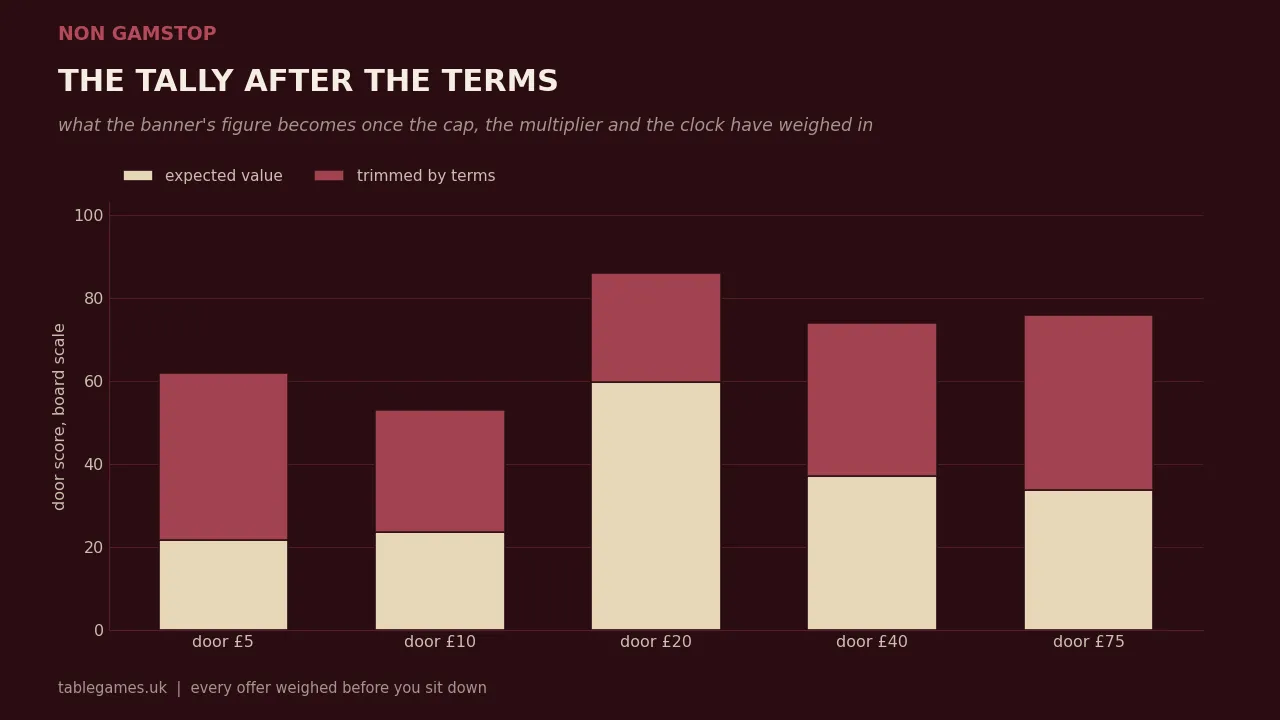
Cash-out arithmetic: coin back to pounds
The way back runs through the same quote that opened the position. Ether bought at £240 is a fixed coin count; sold at a quote 2 per cent lower, the same count returns £235.20 before fees, and nothing about the session's play changed that figure - the market did. The cash-out is therefore a second conversion with a second toll, and it is priced at the moment of sale, not at the moment of request. The two moments are rarely the same price, and the difference belongs on the card.
The operator's side adds its own lines. First withdrawals commonly bring the standard identity checks - proof of identity, proof of address - and the room's payments page carries the method list, the processing queue and any per-method ceilings. Reading those before depositing turns the cash-out from a wait into a scheduled step; skipping the read leaves the first withdrawal as the session's longest unknown, discovered at the moment the player least wants a queue.
The tidy habit is to close the position deliberately. Winnings converted out of coin once play ends fix the session's result in the unit the budget actually spends, and they take the coin's swing off the table until the next funded session. Players who keep a float in coin between sessions are carrying a position, and the card's only demand is that they know it - the arithmetic does not mind either way, and neither does the felt. Chalked twice, the receipt balances in one currency and reads like any other night's card.
ethereum casino: the receipt, chalked twice
Twice, because an ether session is priced at both doors: once when the pounds become coin, once when the coin becomes pounds again. Between the two doors sits the felt, whose prices were posted before the player arrived and will stand after they leave. The card below collects the receipt lines in order, and it is short enough to complete before the payment is made rather than after the first withdrawal stalls.
The card, chalked at both doors:
- Chalk the purchase quote and the coin count it fixes for the float.
- Price the network fee at the current estimate, not at last month's.
- Size the float against the posted minimums and the planned pace.
- Verify the licence page against the issuing authority's public register.
- Close the position at sale and record the second quote beside the first.
An ether-funded table is neither dearer nor cheaper at the felt than any other; the difference lives on the receipt, and the receipt is readable. Two quotes, one fee, one licence check - four figures for ten minutes' reading, and the session starts with its price known rather than guessed. That is the whole case for chalking the card twice: the felt will not surprise anyone, and now the doors will not either.
Frequently asked questions
Do I stake in ether or in pounds?
Both, in a sense: the table posts and debits its minimums in pounds, while the balance that funds them counts in ether at the market's current quote. The round is priced in pounds; the float's value moves with the coin between rounds. Most lobbies display the balance's pound equivalent, which is a quote rather than a promise. The unit question is settled by habit: convert per session to close the exposure, or carry ether and accept the swing.
What are the fees on ethereum deposits?
Two kinds: the exchange cost of buying the ether, and the network's own fee, commonly quoted in gas, which moves with congestion rather than with the amount sent. Because the network fee is broadly fixed per transfer, it weighs heaviest on small floats - a £3 fee on a £60 deposit is 5 per cent before play begins. The wallet's live estimate at confirmation time is the figure to work from, and larger, less frequent deposits spread the cost thinner.
How long does an ethereum withdrawal take?
Two waits in sequence: the network's confirmation, commonly minutes in quiet periods and longer in busy ones, and the operator's processing queue, which varies by room and is published on the cashier page. First withdrawals can also meet identity checks, which add their own time. The honest plan reads the room's published figure before depositing and treats any review's promise as hedging until the room's own page confirms it.
Which regulator oversees an ethereum casino?
Whichever authority issued its licence - commonly an offshore one, with Curaçao's among the most usual. Under the LOK framework, Curaçao licences now issue straight from the regulator there, and its published register is the place an operator's claim gets verified. For a UK player there is no UKGC supervision and no British dispute scheme behind the room, so a complaint runs through the operator to the issuing authority on that authority's terms.
Does the coin price affect my table stake?
Not the posted figure. A £2 stake debits £2 as the layout defines it, and the game's odds never consult the market. What moves is the balance behind the stake: if the quote slips between deposit and session, the float's stake value slips with it, and the posted minimums stay exactly where they were. Players who want the two units pinned together fund with a dollar-pegged token instead, at the cost of that token's own conversion lines.
Are stablecoins a steadier way to fund a session?
Commonly, in the sense that matters here: a dollar-pegged token aims to hold one dollar of value per unit, so the balance's stake value tracks a steady figure instead of the market's mood. The trade is that the rail keeps all its other lines - purchase cost, transfer fee, sale quote - and adds the peg's own dependence on the issuer's reserves. Hedged honestly: steadier, not free, and worth a separate weigh card before the switch.