Slots Free Spins: Two Payers, One Weigh Card
Slots free spins come from two payers: the game's own feature rounds and the room's posted bundles. Each carries a different face value and cap.
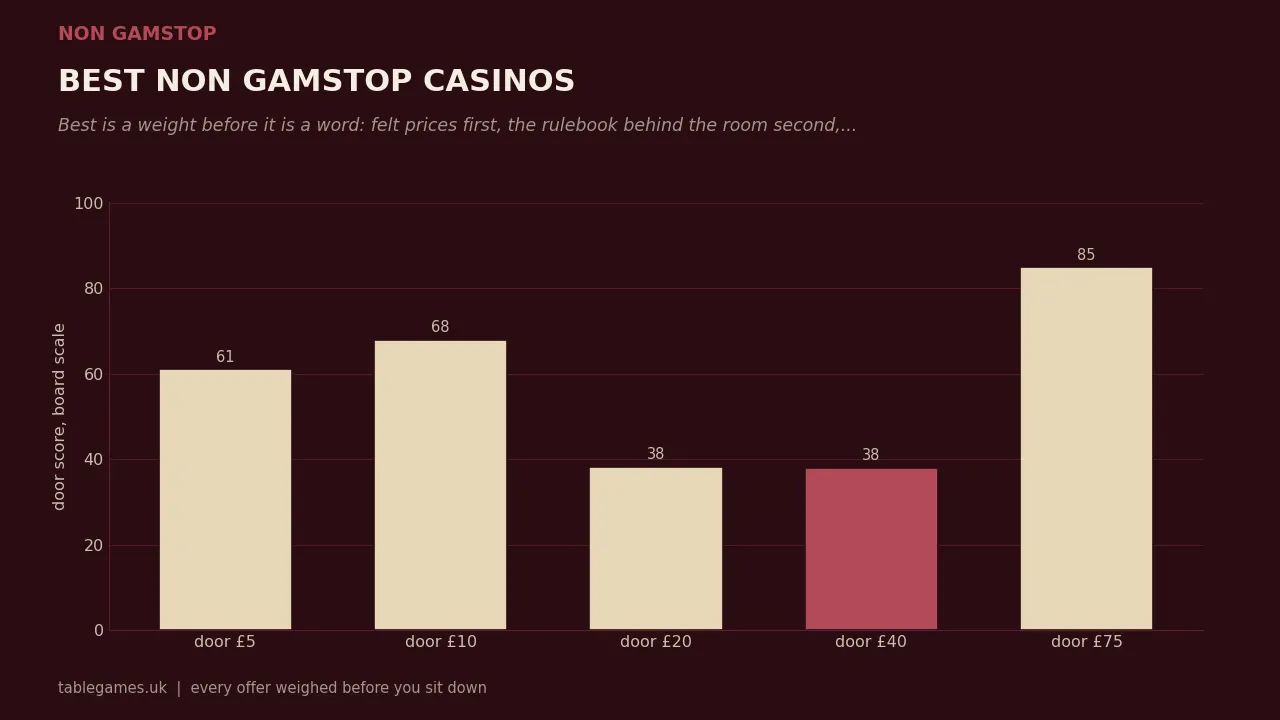
The table score
Four operators, weighed the way a croupier weighs a table: the entry price, the terms weight, the rails on offer, and how fast the cage pays. The scores are ours; the offers are quoted in the operator's own words.
Every card carries its table score out of 10 and four axis bars - licence, terms, payments and withdrawal. Offers move often - the operator's own page is always the current truth.

Welcome bonus €/£5,000 + 500 FS
Weigh the offer
Welcome pack €5,000 + 500 FS + €650 free bet
Weigh the offer
Casino welcome bonus 805% up to €6,400 + 280 FS
Weigh the offer
Welcome package 300% up to €/£1,000 + 150 FS
Weigh the offerCards appear in table-score order, the lower minimum deposit breaking ties. The bars visualise published figures, not a promise; nothing here is a recommendation to gamble, and the operator's own terms decide every claim.
What are slots free spins worth, weighed?
Slots free spins arrive from two payers, and the payer changes the price. The game's own feature round grants rounds to whoever is spinning at the time, funded out of the ordinary stake flow and printed in the game. The room grants bundles on arrival or on a calendar, funded as marketing and printed in the terms. Both are called free; the first is a mechanic, the second is an offer, and the two weigh on different cards despite sharing a name and a reel set.
The shared currency is the stake attached to each round. A feature round runs at the stake that triggered it: ten rounds on a 20p spin are £2.00 of face value, the same money ten ordinary spins would move. A bundle runs at a stake the room fixes, commonly small. Face value is the first figure on either card, and expected return - the posted fraction applied to the face - is the second. Everything else on either card is conditions, and conditions are where the two cards stop resembling each other.
What separates the cards is exactly that word. Feature rounds carry no conditions: their output lands in the balance as any win does, spendable on the account's ordinary terms. Bundles carry wagering, caps and clocks, because the room is buying acquisitions with them. The weigh-in below runs the mechanic first and the offer second and keeps the two tallies separate, because merging them is how a marketing figure borrows a mechanic's honesty. A reader who keeps the two cards apart prices both correctly in under a minute.
The feature round the game grants itself
The feature round is the game paying out in kind. A typical shape grants ten rounds at the triggering stake, so a feature landing on a 20p spin carries £2.00 of face value; a retrigger adds another batch on top, hedged, because retrigger rules are printed per game. The rounds play at the game's ordinary odds - the posted figure governs them as it governs any spin - and their wins settle into the balance without further conditions attached by anyone. The mechanic is older than most of the marketing built around it, and the arithmetic has never changed.
How often the feature lands is the figure the tile never prints. Frequency is commonly described in ranges of spins between triggers, and the honest range is wide, because the spread of outcomes is precisely where titles differ from one another. What can be said plainly: across a few thousand spins the feature rounds become a regular slice of the game's return, and the posted long-run figure already includes them. The feature is not a bonus stacked on the price; it is part of how the price is paid, and it always was.
The player-side reading is calm. A feature round at a 20p box is £2.00 of face value arriving mid-session, worth exactly what ten ordinary spins are worth and no more. Chasing triggers by raising the box raises the cost of every non-feature spin faster than it raises the feature's value, so the arithmetic runs backwards. The box that fits the session plan fits the feature too, and the game's spread, not the player's nerve, decides when it lands - which is the calmest sentence on this page and the most profitable one.
Slots free spins at a glance
- Entry price£10 typical
- Wagering35x on winnings
- Payout window3–6 working days
- Payments4 rails incl. e-wallet
The room bundle: same words, different payer
The bundle is the room granting rounds as an offer, and its stake is the room's choice, commonly pinned small - 9p or 10p a round is the usual territory, hedged. A bundle of forty rounds at 9p carries £3.60 of face value; priced at a game posting 96, about £3.46 of expected return, a 14p gap between face and forecast. The face value and the forecast are the first two figures on the card, and neither is printed on the banner; both are computed from the terms and the game's screen. refills that renew on a calendar covers the variant that repeats.
The bundle's stake discipline matters because the room's 9p is not the player's box. A player who normally spins at 20p is receiving rounds worth less than half their ordinary unit, and the face value says so plainly: £3.60 of 9p rounds is eighteen ordinary 20p spins. The offer is real on its own terms and smaller than it reads; converting the count at the room's stake into the player's stake is the honest reading, and it takes one division.
One more difference from the feature: bundles are granted to accounts rather than to spins, so they can expire, lapse or require a claim inside a window. The mechanic pays whoever is playing; the offer pays whoever claims in time. The window is a figure like any other, and it sits on the card beside the stake and the count, where a missed date costs the whole face value of the batch. A bundle claimed late is worth the same as a bundle never offered, which the calendar keeps honest.
Wagering and caps on bundled spins
The bundle's conditions are where its price hides. Terms attaching 25x to winnings ask that the winnings from the rounds be staked twenty-five times before they leave: on £3.46 of expected return, £86.50 of work, which at the 9p bundle stake is about nine hundred and sixty spins of follow-through. The shape varies - the multiple can sit on the face value instead, or be waived entirely, and the difference between those terms is the difference between a priced offer and a plain one. The multiple is the bundle's real headline, and it never appears on the tile.
Caps close the tail. A £10.00 ceiling on a bundle carrying £3.60 of face value sits well above the forecast, so it trims outliers rather than ordinary runs; tighter caps exist and they trim harder. The no-wagering variant is the clean read: winnings settle as cash, the forecast is the whole price, and the shape is worth its premium wherever it runs on honest stakes. Every version of the card ends at the same place: the cap, in pounds, against the forecast, in pounds.
The comparison line for the section is the player's own plan. Nine hundred and sixty spins of follow-through at a stake the player did not choose is a session or three spent on the room's terms; where that work fits the calendar, the bundle is worth claiming, and where it does not, the feature rounds next door pay without asking anything. The work line, not the headline count, is the figure the claim decision turns on - and the work line is always printed, in the one document the banner never quotes.
| Brand | Welcome offer | Wagering | Min dep. | Withdrawal | Payments | Licence | Table score | Terms |
|---|---|---|---|---|---|---|---|---|
| Pub Casino | Bet £10 get £30–£40 (typical) | 30x–40x by productbest | £10best | 1–3 working days+3d | Visa · PayPal · Paysafecard · Bank transfer-1 rails | UKGC | 8.2 / 10 | Check the terms first |
| PlayOJO | 50–100 wager-free spins (typical range) | Wager-free spins marketed | £10–£20best | 1–2 working days+2d | Visa · Mastercard · Neteller · Pay by mobile-1 rails | UKGC | 7.9 / 10 | Check the terms first |
| Kinghills | Crypto match up to 1 BTC equivalent (typical) | 30x–45x by gamebest | €10 equivalentbest | Instant–24h on cryptobest | Bitcoin · USDT · Visa · Mastercard-1 rails | Offshore | 6.8 / 10 | Check the terms first |
| Ladbrokes | £30–£50 bingo bonus on £10–£20 (typical) | 40x bonus / 2x bingo+10x | £10best | 24–48h e-wallets+48d | Visa · PayPal · Skrill · Bank transfer-1 rails | UKGC | 5.9 / 10 | Check the terms first |
| Sportingbet | 100% up to £/€100 + spins (typical) | 40x typical+10x | £10–£20best | Under 24h e-wallets+24d | Visa · Mastercard · Neteller · Pay by mobile-1 rails | UKGC | 5.9 / 10 | Check the terms first |
| Magic Red | 100% up to €200 + spins (typical range) | 40x typical+10x | €10–€20best | 2–5 working days+5d | Visa · Mastercard · Trustly · Bank transfer-1 rails | Offshore | 5.2 / 10 | Check the terms first |
| Mystake | 100% up to €/£1,000 + spins (typical range) | 35x typical+5x | €20 equivalent+10 | Under 24h on crypto+24d | USDT · BTC · ETH · TRX · Visabest | Offshore | 4.9 / 10 | Check the terms first |
| Roobet | Matched deposit up to €/£500 + spins (typical) | 35x typical+5x | €10 equivalentbest | Under 24h on crypto+24d | BTC · ETH · USDT · MuchBetter-1 rails | Offshore | 4.5 / 10 | Check the terms first |
| Donbet | Matched deposit up to €/£500 + spins (typical) | 40x typical+10x | €10 equivalentbest | 24–48h (crypto fastest)+48d | Bitcoin · USDT · Visa · Mastercard-1 rails | Offshore | 4.1 / 10 | Check the terms first |
| Rainbet | Crypto match up to 1 BTC equivalent (typical) | 40x typical+10x | €20 equivalent+10 | Under 24h on crypto+24d | BTC · ETH · USDT · MuchBetter-1 rails | Offshore | 4.1 / 10 | Check the terms first |
| NineWin | Matched deposit up to €/£500 + spins (typical) | 45x typical+15x | €10–€20best | 24–48h (crypto fastest)+48d | BTC · ETH · USDT · MuchBetter-1 rails | Offshore | 3.8 / 10 | Check the terms first |
| Fat Pirate | Crypto match up to 1 BTC equivalent (typical) | 45x typical+15x | €20 equivalent+10 | 24–48h (crypto fastest)+48d | Bitcoin · Litecoin · Visa · Bank transfer-1 rails | Offshore | 3.8 / 10 | Check the terms first |
Stake sizes inside features and bundles
Stake sizes decide what either kind of round is worth, so they are read first. In a feature, the stake is the player's own: the round inherits whatever box was spinning when it triggered, so a trigger at 20p carries £2.00 per ten rounds and a trigger at £1.00 carries £10.00. The same mechanic at two boxes is two different figures, and the box is the only variable on that card. The feature is par value by construction, which is why no room can reprice it and every room can reprice its own bundles.
In a bundle, the stake is the room's: fixed in the terms, commonly at the small end of the dial, and not adjustable from the player's side. The count reads larger at a small stake - a hundred rounds sounds tall until it is priced at 10p, where it is £10.00 of face value, the same money as fifty 20p spins. the clean batch with no conditions shows what the same count is worth once the wagering drops away entirely.
The honest unit for both shapes is face value per round, converted to the player's ordinary box. A feature round is always at par; a bundle round is whatever fraction of par the room's stake sets. Once both are converted, the two payers can be weighed on one line, which is the entire point of the card - and once they share a line, neither can borrow shine from the other. The conversion is one division, and it settles more arguments than any adjective on the tile.
The spread around the free rounds
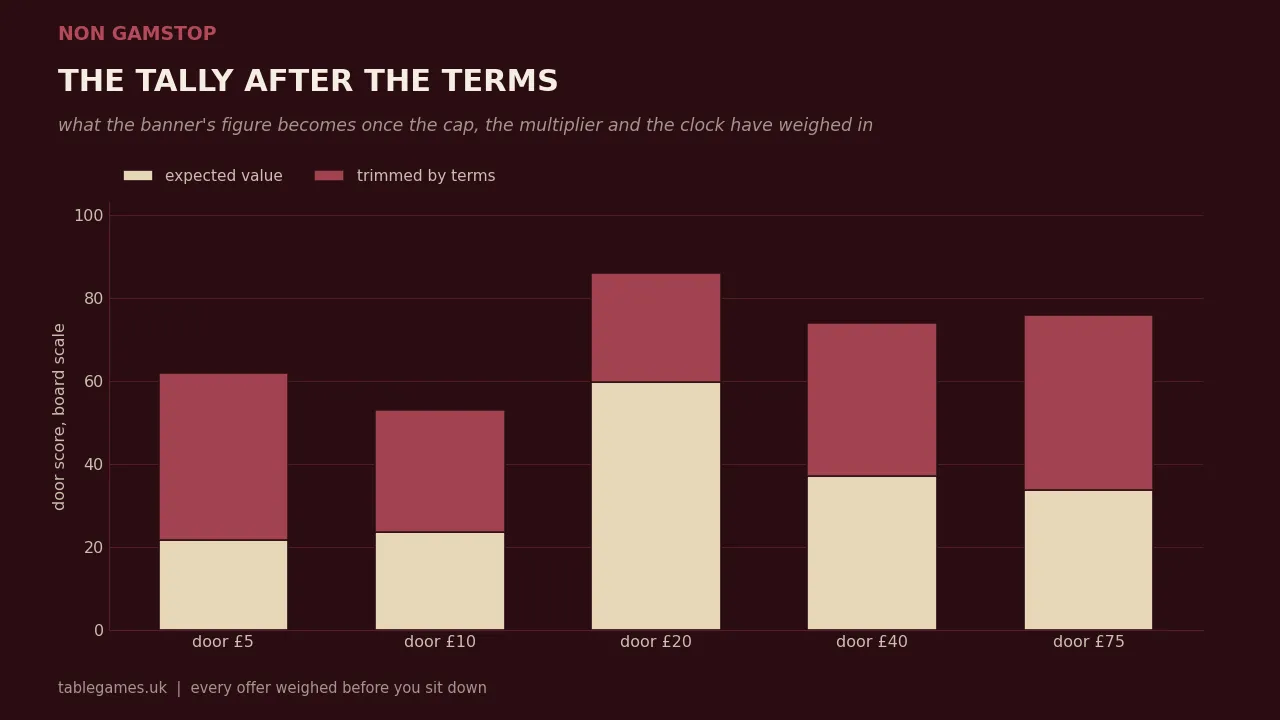
The spread describes how the value of free rounds arrives. Narrow-spread games return in small steps, so a feature's £2.00 of face value trickles back across the rounds; wide-spread games concentrate the return, so most feature runs return little and one returns a multiple. The posted figure is identical across both shapes - the spread is the shape of the ride, not the price of the machine - and it is read from behaviour over volume rather than from any word on the tile. A thousand practice spins on the float next door reads it faster than any label.
Practically, the spread decides how a bundle feels more than what it pays. A wide-spread game at a 9p bundle stake can complete its entire run without a return worth the name, with the forecast hiding in the tail the cap then trims; a narrow one shows its expected return across the rounds almost evenly. Where one boundary line belongs: rooms outside the British rulebook carry the same mechanics with the same kinds of printed figures, though the licence behind them differs and the recourse differs with it.
Weighed honestly, the spread is the softest column on the card: real, readable over volume, and impossible to verify from a banner. It belongs last in the reading order for the same reason the cap belongs near the front - the cap is printed, the spread is inferred, and printed figures outrank inferred ones on every page of this site. Free rounds do not change that order; they only give it something free to rank, and the ranking still costs the same care.
slots free spins: two tallies, chalked
The closing chalk runs the two payers in one order. Feature rounds: face value at the player's own stake, no conditions, already inside the posted price. Bundles: face value at the room's stake, conditions attached, priced by the work the terms demand and the cap that trims them. Both convert to the same unit - face value at the box actually played - and once converted, neither can be sold as more than it is. The card, in the same order every time:
The two-payer card, chalked in order:
- Price feature rounds at the stake that triggered them; the box is the value.
- Convert bundle counts at the room's stake before reading the headline count.
- Compute expected return from the game's posted figure, not from the banner.
- Multiply the wagering multiple against winnings to price the follow-through work.
- Check the cap against the forecast to see what it actually trims.
- Prefer the no-wagering shape wherever it is offered at an honest stake.
Weighed whole, slots free spins are one mechanic and one marketing shape sharing a name. The mechanic pays at par with no conditions and asks nothing but play; the marketing shape pays at a stake the room set and prices through wagering, caps and clocks. Run both through the same conversion, chalk the two tallies side by side, and the word free finally reads as what it is - a figure waiting to be computed, on a page that computes it.
Frequently asked questions
What are in-game free spins worth?
Exactly their face value at the triggering stake. Ten rounds on a 20p spin are £2.00 of face value - the same money ten ordinary spins move - returning whatever the game's posted figure implies over volume. The rounds carry no extra conditions, and the posted long-run figure already includes them, so they are part of the machine's price rather than a bonus stacked on top of it.
How is a spin bundle priced?
By three figures: the room's stake per round, the count, and the conditions. Forty rounds at 9p is £3.60 of face value, forecasting about £3.46 at a game posting 96; wagering on winnings then adds work - 25x would ask about £86.50 - and a cap trims the tail. None of the three appears on the banner; all appear in the terms and on the game's own screen, which is why the card starts there rather than at the headline.
Why are bundle stakes so small?
Because the stake is the room's cost control, not the player's box. Rounds at a pinned 9p or 10p make the face value of a headline count modest: a hundred rounds at 10p is £10.00 of face value, the same money as fifty 20p spins. The count reads large at the small stake; the conversion to the player's ordinary box is the honest reading, and it is the first sum worth running on any bundle that lands in an account.
Do free spins winnings need wagering?
On feature rounds, never; on bundles, commonly, and the terms say which. Where a multiple applies to winnings - 25x on a forecast £3.46 is about £86.50 of work - the spin count of follow-through at the bundle stake can reach the high hundreds. The no-wagering variant settles winnings as cash and is the cleanest shape in the class wherever it runs.
What is a retriggered feature worth?
A retrigger grants another batch of feature rounds mid-feature, at the same stake, and its value is the same arithmetic repeated: five more rounds at 20p are £1.00 of face value. Retrigger rules are printed per game and vary widely, so the figure is hedged rather than quoted. Weighed plainly, a retrigger is the game continuing to pay in kind, nothing more.
Do the same offers run outside the British rulebook?
The mechanics do - features and bundles work identically and print the same kinds of figures - but the backing differs. Licences outside Britain are real yet not British ones, so the register, the domestic stake ceiling and the national complaint routes stop at the line, and bundle terms can run sharper without domestic limits. Read the licence entry on the operator's own site, then match it on the regulator's public register, before claiming anything.