USDT Casinos: the Tether Rail on the Layout
A dollar-pegged coin moves the stake without a bank in the middle. The rail prices in spreads and network fees, and the licence reads on a foreign register.
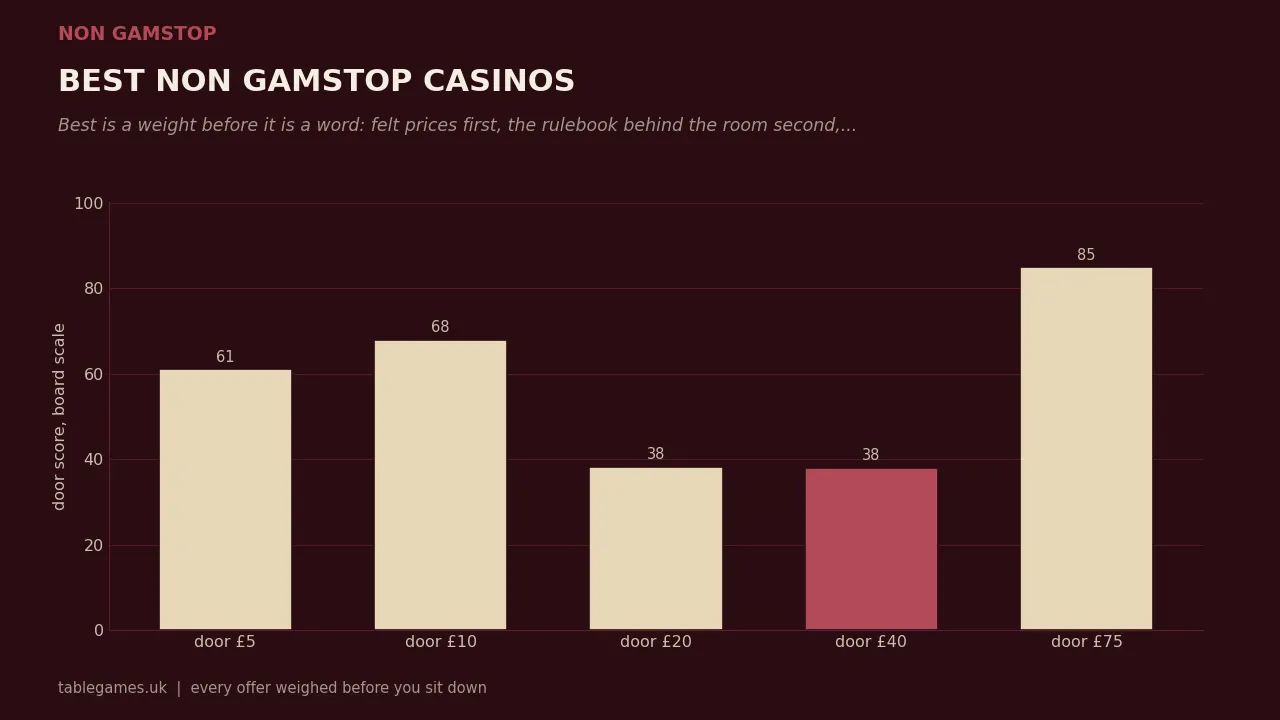
The table score
Four operators, weighed the way a croupier weighs a table: the entry price, the terms weight, the rails on offer, and how fast the cage pays. The scores are ours; the offers are quoted in the operator's own words.
Every card carries its table score out of 10 and four axis bars - licence, terms, payments and withdrawal. Offers move often - the operator's own page is always the current truth.

Welcome bonus €/£5,000 + 500 FS
Weigh the offer
Welcome pack €5,000 + 500 FS + €650 free bet
Weigh the offer
Casino welcome bonus 805% up to €6,400 + 280 FS
Weigh the offer
Welcome package 300% up to €/£1,000 + 150 FS
Weigh the offerCards appear in table-score order, the lower minimum deposit breaking ties. The bars visualise published figures, not a promise; nothing here is a recommendation to gamble, and the operator's own terms decide every claim.
What a USDT stake actually is
USDT is a coin built to hold a steady value, commonly quoted near one US dollar, and a USDT casino takes stakes and pays balances in that unit. The peg is an aim rather than a law, so the honest phrasing is commonly near the dollar, because pegs have slipped in stressed markets before and could again. What the rail promises is simpler than stability: a balance that moves over a network without a bank sitting in the middle of it, at hours a bank counter does not keep.
At the tables themselves, nothing moves. A single-zero roulette layout holds 37 pockets and 2.70 per cent of turnover, house-side, across the long run; a blackjack natural still pays 3 to 2; the posted minimums stay posted on each layout's own panel. What moves is the unit the purse counts in: the stake box posts one figure, the balance holds another, and a quote stands between the two. A player who deposits the pound equivalent of 200 USDT has chosen a rail as much as a room, and the rail's own charges are the subject of the sections that follow.
This page weighs the rail in the order its costs arrive. The spread and the network fee come first, because they are paid before any round is dealt. The register behind the room comes second, because it decides who answers when a payout stalls. The peg and the pound come third, since a dollar coin held by a British player carries an exchange position whether or not it was wanted. Pace, bonuses and a closing card follow, and every figure on the page is one a player can check before money moves.
The spread and the fee: the rail's two charges
Buying USDT with pounds carries two charges that arrive before any stake. The first is the spread between the buy quote and the mid-market rate, which on retail exchanges commonly lands somewhere between a fraction of a per cent and a couple of per cent. The second is the network fee, a flat cost to move the coin, which weighs heaviest on small transfers. A worked line: £200 converted at a 1.5 per cent spread costs £3 before a hand is dealt, and a £4 flat fee would lift that toll to £7, or 3.5 per cent of the float.
Frequency turns those two charges into a policy. The flat fee is paid every time the coin moves, so ten transfers of £30 pay it ten times, while one transfer of £300 pays it once; the spread, being a percentage, does not care how the movements are sliced. The arithmetic pushes regular players toward fewer, larger conversions sized to a week of play rather than an evening, and toward topping up the balance only when the tables demand it. Both figures belong on the card before the first deposit, because both are paid whether or not the session wins.
The rail family matters here, because a dollar-pegged coin can run on more than one network and the networks price differently. how the ether rail splits the same fee weighs the equivalent charges on a different chain, where gas prices swing with congestion rather than with the size of the transfer. The lesson generalises across all of them: the fee is a property of the network and the moment, not of the room, and the wallet's own quote at the second of transfer is the only figure worth writing down.
Usdt casino at a glance
- Entry price£40 typical
- Wagering40x on bonus
- Payout window2–3 working days
- Payments4 rails incl. e-wallet
The register behind the room: reading the licence
A USDT casino's licence is the page that settles where a complaint lands, and it is checked in two places rather than one. The operator's own licence page shows the issuing authority and, in most cases, a reference number; the authority's public register is where that claim is tested. Rooms taking USDT commonly hold offshore licences, with Curaçao among the usual names, and the framework there has been rebuilt inside the last few years: the master-licence structure has given way to direct licensing under the LOK, with legacy holders moved across during a window that closed during 2025.
The register is the checkpoint of the arrangement, and the passport metaphor earns its keep. A passport is read at the border of the place that printed it, and a licence is read on the register of the authority that granted it; neither document promises anything about the player's home country. So the ten-minute check runs: read the operator's licence page, then read the Curaçao Gaming Authority's register, and treat any mismatch between the two - or an absence from both - as the cheapest bad news a player can buy.
Distance is the honest summary of what the licence does not cover. British dispute schemes are built for British-licensed rooms, so an offshore complaint runs through the operator first and its regulator second, at whatever pace that office keeps. The national self-exclusion register spans British-licensed rooms only, and a registration made there does not follow a player through this particular door. The licence is real on its own terms; it simply governs a different relationship, under a different authority, than a British player might assume - which is why the register check sits second on this page and not last.
The peg and the pound: two floats on one balance
A dollar coin in a British player's purse carries two exposures at once. The peg itself can drift, and has done in stressed markets, so commonly near a dollar is the honest reading rather than exactly one. The pound-dollar rate adds its own move on top, because the float's spending power at the tables is set in pounds even while the balance is counted in coin. Worked plainly: a £200 float that slips 2 per cent against the pound before the first stake is a £196 float, and the missing £4 never touched a table.
Set that against the felt's own price. The house fraction on a single-zero roulette layout is 2.70 per cent of turnover, so an hour at £2 a round moves about £120 through the box and books roughly £3.24 for the house. A 2 per cent currency move costs more than that hour's edge without a single round being dealt. The comparison is the reason conversions sized to the session beat balances held for the month: the shorter the coin is held, the smaller the fraction of the float exposed to a move nobody placed a bet on.
One British contrast belongs on the card, hedged as context rather than complaint. Remote Gaming Duty, charged on a British licensee's gross gambling yield, doubled to 40 per cent from April 2026, and the squeeze shows up in the bonus economics of UK-licensed rooms; offshore offers sit outside that duty entirely. That goes some way to explaining why coin-funded promotions can read larger on the banner. The reply is the same as anywhere else on the site: weigh the terms, not the headline, and let the card do the ranking.
| Brand | Welcome offer | Wagering | Min dep. | Withdrawal | Payments | Licence | Table score | Terms |
|---|---|---|---|---|---|---|---|---|
| PlayOJO | 50–100 wager-free spins (typical range) | Wager-free spins marketed | £10–£20+5 | 1–2 working days+2d | Visa · Mastercard · Neteller · Pay by mobile-1 rails | UKGC | 7.9 / 10 | Check the terms first |
| Fabulous Bingo | Spend £10 play with £40–£70 (typical) | 2x–4x bingo / 40x pokiesbest | £5best | Under 24h to PayPal+24d | Visa · PayPal · Skrill · Bank transfer-1 rails | UKGC | 7.6 / 10 | Check the terms first |
| 888 Sport | 100% up to £/€100 + spins (typical) | 40x typical+38x | £5–£10best | 1–3 working days+3d | Visa · Mastercard · Skrill · Apple Pay-1 rails | UKGC | 7.5 / 10 | Check the terms first |
| Velobet | 100% up to €/£1,000 + spins (typical range) | 30x–45x by game+28x | €10 equivalent+5 | Instant–24h on cryptobest | Bitcoin · Litecoin · Visa · Bank transfer-1 rails | Offshore | 6.8 / 10 | Check the terms first |
| Casino Kings | 100% up to £/€100 + spins (typical) | 35x typical+33x | £10–£20+5 | Under 24h e-wallets+24d | Visa · Mastercard · Skrill · Apple Pay-1 rails | UKGC | 6.3 / 10 | Check the terms first |
| Mystake | 100% up to €/£1,000 + spins (typical range) | 35x typical+33x | €20 equivalent+15 | Under 24h on crypto+24d | USDT · BTC · ETH · TRX · Visabest | Offshore | 4.9 / 10 | Check the terms first |
| Gamdom | Matched deposit up to €/£500 + spins (typical) | 40x typical+38x | €10 equivalent+5 | Under 24h on crypto+24d | USDT · BTC · ETH · TRX · Visabest | Offshore | 4.5 / 10 | Check the terms first |
| Rolletto | 150% match + rakeback (typical range) | 35x typical+33x | €10 equivalent+5 | 24–48h (crypto fastest)+48d | Bitcoin · Litecoin · Visa · Bank transfer-1 rails | Offshore | 4.5 / 10 | Check the terms first |
| Roobet | Matched deposit up to €/£500 + spins (typical) | 35x typical+33x | €10 equivalent+5 | Under 24h on crypto+24d | BTC · ETH · USDT · MuchBetter-1 rails | Offshore | 4.5 / 10 | Check the terms first |
| Rainbet | Crypto match up to 1 BTC equivalent (typical) | 40x typical+38x | €20 equivalent+15 | Under 24h on crypto+24d | BTC · ETH · USDT · MuchBetter-1 rails | Offshore | 4.1 / 10 | Check the terms first |
| NineWin | Matched deposit up to €/£500 + spins (typical) | 45x typical+43x | €10–€20+5 | 24–48h (crypto fastest)+48d | BTC · ETH · USDT · MuchBetter-1 rails | Offshore | 3.8 / 10 | Check the terms first |
| Fat Pirate | Crypto match up to 1 BTC equivalent (typical) | 45x typical+43x | €20 equivalent+15 | 24–48h (crypto fastest)+48d | Bitcoin · Litecoin · Visa · Bank transfer-1 rails | Offshore | 3.8 / 10 | Check the terms first |
Pace of the rail: confirmations, queues and the clock
Speed on a USDT rail comes in two parts. The network confirms a transfer, commonly within minutes when its fee is paid, and the room credits the balance after its own confirmation count, a figure that sits on the cashier page rather than in any review. Withdrawals run the pattern in reverse, with the operator's processing queue added in front of the network's part. Both ends are hedged here because both vary: the working numbers are the room's published window and the wallet's estimate at the moment of transfer, and neither is promised by the coin's name.
Inside the session, pace belongs to the tables rather than the rail. A live blackjack shoe commonly deals 50 to 70 hands an hour, a live roulette wheel commonly spins 35 to 50 times, and RNG tables run to hundreds of rounds, so the same stake box turns over very different totals by format. The rail's speed matters at the edges of the evening - funding the float, emptying it - and the felt's pace matters through the middle. Weighed honestly, a fast rail that funds a fast table is a combination, not a virtue.
For contrast on the coin side, where the bitcoin float runs slower prices the original rail, whose fees and confirmation waits move with a market rather than a peg. A dollar-pegged balance spares the player that market's swings; it does not spare them the queue at the cage, which is the room's figure, not the coin's. Reading the two pages side by side separates the rail's habits from the coin's, which is the split most marketing blurs.
Bonuses on a USDT float: the terms that price them
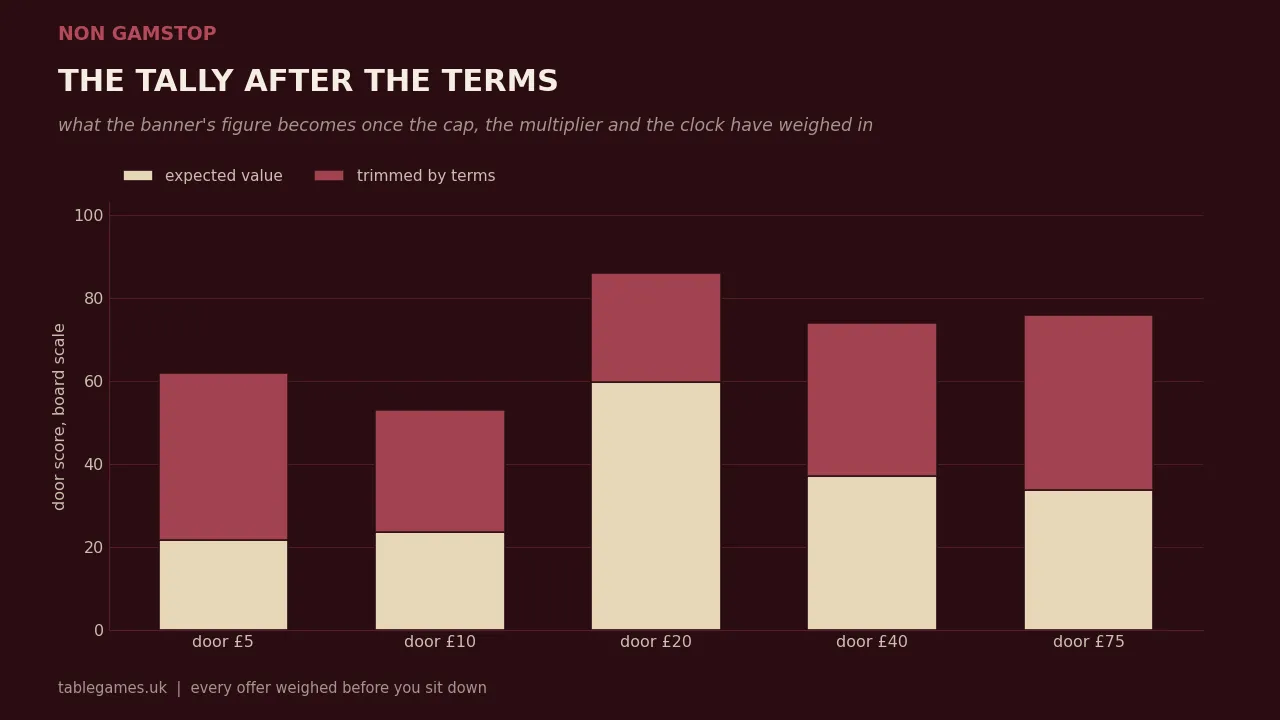
Table-game players should read a coin-funded bonus from the weighting line first. Offshore terms commonly weight slots at 100 per cent and tables at anything from nothing to 10 per cent, with live tables sometimes excluded outright; each offer states its own figures, and the promotion's own terms page is the only source worth quoting. A £100 bonus carrying 30 times wagering at a 10 per cent table weighting is not £3,000 of play but £30,000, which at £5 a round is 6,000 rounds before the bonus releases.
That arithmetic is the price of the banner. An hour at a live table runs 50 to 70 hands, so 6,000 rounds is a season of evenings, and the offer was priced on the assumption most players will not finish the distance. None of this makes the promotion a trick; it makes it a figure, and figures can be chalked. The listed casinos on the board above state their weightings in their own terms, and those pages outrank any summary, including this one.
Caps complete the read. Maximum conversion figures, excluded games, time limits and maximum stakes while wagering are all printed in the deal's own terms, and each caps the bonus from a different side. A bonus read from the banner alone is a price taken without the ticket; the same bonus read from the terms is an offer that can be declined on its numbers, which is the whole discipline this site exists to teach.
The weigh card: five lines before the transfer
Five lines settle the USDT question before any coin moves, and all five are checkable from a sofa. The spread and the fee, both ways. The register entry behind the room. The peg exposure the float will carry. The confirmation count at the cage. And the weighting behind any bonus the banner is shouting about. Carded in that order, the rail prices itself; skipped, the first surprise arrives at the worst moment a surprise can arrive, which is mid-withdrawal.
Chalked before the first conversion:
- Price the spread and the network fee on the way in and out.
- run the operator's licence page, then the authority's own register.
- Size conversions to the session, and convert back before logging off.
- Check the cashier page for the confirmation count and the payout window.
- Read the bonus weighting for tables before claiming any coin-funded offer.
- Assume the peg can drift, and treat a float held overnight as a position.
The felt keeps its own figures whatever unit funds it, and that is the reassurance in the card: the wheel's fraction, the natural's price and the banker's commission are known, posted and unchanged by the rail. The variable lines - spread, fee, peg, register - are all on the punter's side of the counter, and all of them yield to ten minutes of reading. That is the trade a USDT stake actually offers: a faster door, priced in homework.
Frequently asked questions
Is USDT the same as Bitcoin?
No, and that difference is the whole point of the rail. Bitcoin's value floats on a market, while USDT is issued with the aim of holding a value commonly near one US dollar, so the balance's unit behaves more like cash in a foreign currency than like a swinging asset. The peg is maintained by the issuer and has wobbled in stressed markets before, so near is the operative word, but the two coins answer different questions and belong on different pages of the card.
What does a USDT deposit cost in fees?
Three figures: the spread on the buy quote, the flat network fee for the transfer, and the same pair again in reverse when winnings are converted back to pounds. Hedged, because exchanges and networks price differently and congestion moves the flat fee around: on a small float the pair can reach a few per cent of the deposit, and on larger, less frequent movements the percentage slips. The wallet's quote at the moment of transfer is the figure to work from.
Are USDT casinos licensed for British players?
Rooms taking USDT commonly hold offshore licences, with Curaçao among the usual issuers; the licence is a real document from a real authority, and the authority is not British. The practical test is documentary: say the operator's licence page for the authority and reference, then read that authority's public register to see the entry as the regulator publishes it. Complaints on an offshore room route to the operator and its regulator rather than to a British scheme, which is the distance the licence actually describes.
Can I withdraw winnings in USDT?
In most cases a room that takes USDT deposits pays USDT withdrawals back to the same kind of wallet address, hedged because cashier setups differ room by room. Two waits apply in sequence: the operator's processing queue, then the network's confirmation, and the cashier page carries the room's own window for the first of them. Once the coin lands, its pound value is whatever the exchange says at the moment of sale, which closes the peg discussion above.
Does my balance move in pound terms while it sits?
It can, twice over. The coin aims to hold its dollar value but has drifted in stressed markets, and the pound-dollar rate moves independently, so a balance carried in USDT by a British player is a small exchange position whether or not it was chosen. Sizing conversions to the session and converting back before logging off keeps the exposure to hours rather than weeks. Held for months, the same balance is a market view nobody meant to take.
Are table bets counted toward wagering a USDT bonus?
Commonly at a fraction of their face value, and sometimes not at all. Offshore terms typically weight slots at 100 per cent and tables from nothing up to 10 per cent, with some live tables excluded outright, and each offer's own terms page is the source of truth. A 30 times requirement on a £100 bonus with a 10 per cent table weighting asks for £30,000 of staked play, which is the figure to weigh before claiming rather than after.