Free Spins No Deposit: Weighing a Spin by Its Stake
One spin has one price and one long-run fraction. The whole offer can be weighed on a single line before you sign up for it.
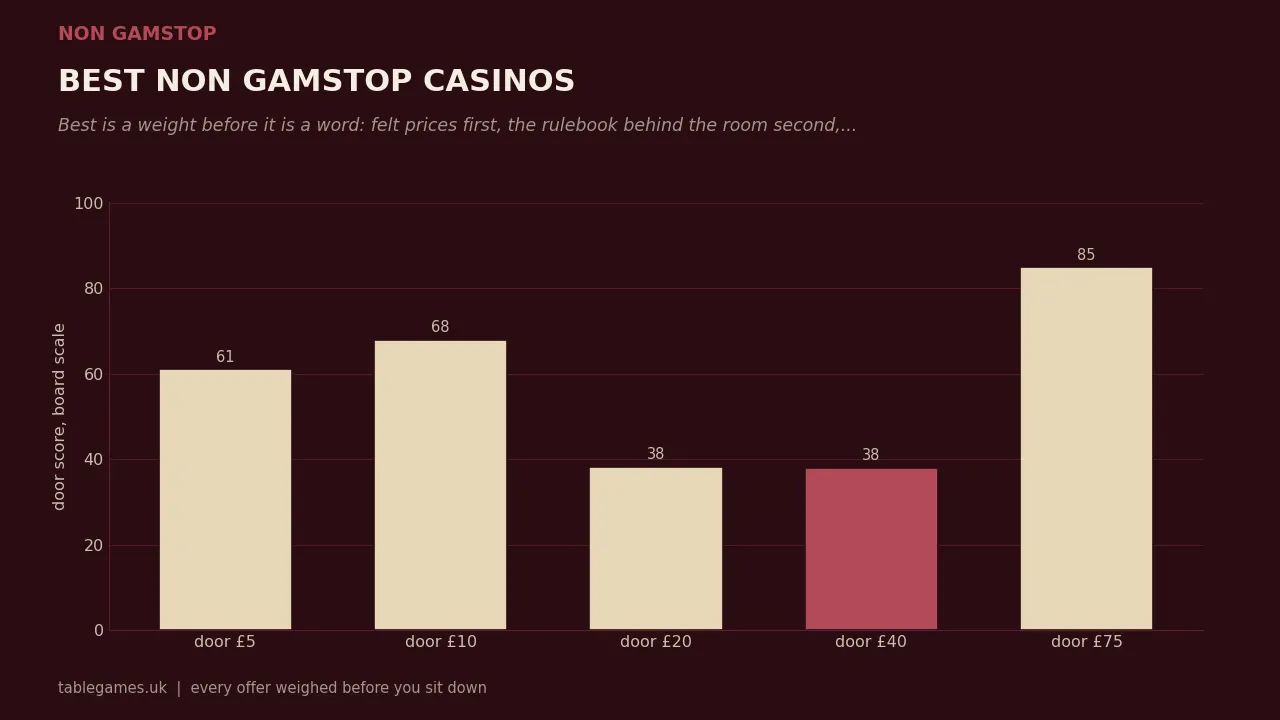
The table score
Four operators, weighed the way a croupier weighs a table: the entry price, the terms weight, the rails on offer, and how fast the cage pays. The scores are ours; the offers are quoted in the operator's own words.
Every card carries its table score out of 10 and four axis bars - licence, terms, payments and withdrawal. Offers move often - the operator's own page is always the current truth.

Welcome bonus €/£5,000 + 500 FS
Weigh the offer
Welcome pack €5,000 + 500 FS + €650 free bet
Weigh the offer
Casino welcome bonus 805% up to €6,400 + 280 FS
Weigh the offer
Welcome package 300% up to €/£1,000 + 150 FS
Weigh the offerCards appear in table-score order, the lower minimum deposit breaking ties. The bars visualise published figures, not a promise; nothing here is a recommendation to gamble, and the operator's own terms decide every claim.
What is a free spin actually worth?
A free spin's worth is two figures and one gap between them. The price is the stake the spin carries, fixed by the promoter; the fraction is the game's published long-run return; the gap is everything the terms hang on whatever lands. One spin staked at 10p on a machine returning 95 per cent in the long run is worth about 9.5p per go, averaged across a very large number of goes and guaranteed on none of them.
The free in the headline describes the entry, not the arithmetic. The player pays nothing to take the batch, and the room prices that convenience honestly: the spins carry a fixed stake the player does not choose, on a game the player usually does not choose either. Value therefore arrives as an expectation rather than a sum, and sessions land on both sides of it, which matters more as the batch grows and the swings grow with it.
A third figure appears only after the batch has run: what the winnings must do before they leave. Some batches pay winnings as withdrawable cash with nothing attached; the commoner shape credits them as bonus funds with a wagering multiple tied on, and the 9.5p expectation then has to survive a clearance before it is money. This page takes the figures in order - stake, fraction, wagering - and finishes with the rulebooks that print them.
The spin offers on the board above differ mainly in these three figures, which is why the page weighs the method rather than any headline. Batch size moves the total; the stake box moves the per-spin line; the terms move everything they touch. A reader who can price one bundle honestly can price the whole class, and the pricing costs two minutes with the terms rather than a deposit.
The stake line: what each spin costs the promoter, not you
Every free spin carries a stake, and the player does not set it. The promoter fixes the line - commonly 10p on current offers, though boxes run lower and higher by promotion - and the whole batch is priced from that figure. Forty spins on a 10p box carry £4.00 of face value; the same forty at 25p carry £10..00; at 2p they carry 80p. The headline prints the count of spins; the stake hides in the terms.
The stake line is the denominator of everything that follows. The expected return scales from it, the wagering attached to the winnings scales from whatever it produces, and comparisons between offers collapse into nonsense unless the stake is read first. Two rooms advertising forty spins can differ fivefold in face value without altering a word of the banner, and the difference is only visible at the stake line.
Bundles aimed at registration are commonly priced at the smaller boxes, which trims the face value as surely as a smaller count would. [[[[the registration arithmetic at twenty-five]]]] runs this page's method across a smaller headline, and the two reads agree on the order of operations: stake first, count second, everything else after. The per-spin figure is the only line in the offer that cannot be argued with once it has been read.
One distinction belongs beside the stake line, because the terms often contain two different stakes. The first is the fixed stake the spins themselves run at. The second is the maximum stake the player may wager while any winnings are clearing, commonly set at £2 to £5 a round. The two sit in different columns of the receipt, and confusing them leads to reading a clearance cap as a spin price, which overstates the batch's freedom considerably.
Free spins no deposit at a glance
- Entry price£10 typical
- Wagering45x on spin winnings
- Payout window1–3 working days
- Payments4 rails incl. e-wallet
The long-run fraction: expected results from a spin batch
The fraction is the machine's published long-run return, and it is the one figure in the offer the promoter does not set per promotion. Games commonly publish it on the information screen, where it reads as the share of stakes the game pays back across a very long run. Worked at the batch: forty spins on a 10p box carry £4.00 of face value, and a machine publishing 95 per cent expects to return about £3.80 of it.
An expectation of £3.80 is not a delivery of £3.80. Forty spins make a small sample, and small samples swing widely on both sides; a batch can return nothing or several times its face value, and both results live inside the same published fraction. The figure is honest only at the scale it was measured at, which is thousands of spins rather than forty, and a clerk weighing a batch keeps the two scales firmly apart.
The fraction also depends on which machine the spins are pinned to, and rooms commonly pin batches to named games. A bundle fixed to a machine publishing 93 per cent expects £3.72 from the same £4.00 of face value; the eight pence looks trivial until it is compared across a class of offers, where it repeats every time the batch is claimed. The eligible machine is therefore a price line, not a garnish.
Comparing offers per pound of face value keeps the fractions on one axis. A batch returning 95p per pound of face value out-prices a batch returning 93p per pound, whatever the two headlines say about spin counts, and the difference survives every claim. Headline counts and themes decide how an offer looks; the fraction per pound decides what it weighs, and only the second belongs on the card.
Wagering on spin winnings: the multiple that follows
The commonest drag on spin winnings is a wagering multiple: the batch's winnings arrive as bonus funds and must be staked a set number of times before they convert to cash. Worked at the page's batch, £3.80 of expected winnings at a 30x multiple books £114 of turnover before anything converts. The multiple does not multiply the stake the spins ran at; it multiplies whatever lands, which is why the fraction column comes before it on the card.
Clearance runs inside the box the terms set for it. With a £2 maximum stake while the wagering runs, £114 of turnover needs at least 57 rounds, and the rounds take minutes at machine pace or evenings at restricted pace, depending on which games the terms allow to carry the wagering. A multiple that reads small in isolation becomes a schedule the moment it meets the box, and the box is always a terms figure.
The conversion cap bounds the whole exercise from above, and it is read before the multiple, not after. A cap set at £3 trims the batch's expected £3.80 before the first spin lands; a cap set at £25 sits far enough above the expectation never to engage. how free credit carries its own ceiling weighs caps ceiling-first across the wider free-money board, and the order there is identical: the ceiling sizes the offer before any other figure is allowed to speak.
Expiry finishes the column. Winnings credited as bonus funds commonly carry their own clock, separate from the one on the spins, and an unconverted balance at expiry is usually forfeited with the offer. A short clock on a large multiple is the harshest combination in the class: the work is scaled to the winnings and the time is scaled to the banner, and the two rarely agree. Both figures are printed before the claim, which is the only comfort the column offers.
| Brand | Welcome offer | Wagering | Min dep. | Withdrawal | Payments | Licence | Table score | Terms |
|---|---|---|---|---|---|---|---|---|
| Dream Vegas | Matched deposit up to £/€200 (typical) | 35x typical+5x | £5–£10best | 1–3 working days+3d | Visa · Mastercard · Neteller · Pay by mobile-1 rails | UKGC | 7.8 / 10 | Check the terms first |
| Admiral Casino | Matched deposit up to £/€200 (typical) | 30x–40x by productbest | £10+5 | 24h e-wallets, 2–5 days cards+5d | Visa · Mastercard · Neteller · Pay by mobile-1 rails | UKGC | 7.7 / 10 | Check the terms first |
| Kinghills | Crypto match up to 1 BTC equivalent (typical) | 30x–45x by gamebest | €10 equivalent+5 | Instant–24h on cryptobest | Bitcoin · USDT · Visa · Mastercard-1 rails | Offshore | 6.8 / 10 | Check the terms first |
| Velobet | 100% up to €/£1,000 + spins (typical range) | 30x–45x by gamebest | €10 equivalent+5 | Instant–24h on cryptobest | Bitcoin · Litecoin · Visa · Bank transfer-1 rails | Offshore | 6.8 / 10 | Check the terms first |
| 666 Casino | 100% up to £/€100 + spins (typical) | 30x–40x by productbest | £10–£20+5 | Under 24h e-wallets+24d | Visa · Mastercard · PayPal · Bank transfer-1 rails | UKGC | 6.6 / 10 | Check the terms first |
| QuinnBet | 100% up to £/€100 + spins (typical) | 35x typical+5x | £10+5 | Under 24h e-wallets+24d | Visa · Mastercard · Skrill · Apple Pay-1 rails | UKGC | 6.3 / 10 | Check the terms first |
| 10bet | 100% up to €200 + spins (typical range) | 40x typical+10x | €20+15 | 1–3 working days+3d | Visa · Mastercard · Skrill · Neteller-1 rails | Offshore | 5.7 / 10 | Check the terms first |
| Boneenbet | 100% up to €/£1,000 + spins (typical range) | 35x typical+5x | €10 equivalent+5 | 24–48h (crypto fastest)+48d | Bitcoin · Litecoin · Visa · Bank transfer-1 rails | Offshore | 4.5 / 10 | Check the terms first |
| Gamdom | Matched deposit up to €/£500 + spins (typical) | 40x typical+10x | €10 equivalent+5 | Under 24h on crypto+24d | USDT · BTC · ETH · TRX · Visabest | Offshore | 4.5 / 10 | Check the terms first |
| Rolletto | 150% match + rakeback (typical range) | 35x typical+5x | €10 equivalent+5 | 24–48h (crypto fastest)+48d | Bitcoin · Litecoin · Visa · Bank transfer-1 rails | Offshore | 4.5 / 10 | Check the terms first |
| Rainbet | Crypto match up to 1 BTC equivalent (typical) | 40x typical+10x | €20 equivalent+15 | Under 24h on crypto+24d | BTC · ETH · USDT · MuchBetter-1 rails | Offshore | 4.1 / 10 | Check the terms first |
| Fat Pirate | Crypto match up to 1 BTC equivalent (typical) | 45x typical+15x | €20 equivalent+15 | 24–48h (crypto fastest)+48d | Bitcoin · Litecoin · Visa · Bank transfer-1 rails | Offshore | 3.8 / 10 | Check the terms first |
Two rulebooks: where banner and terms split
Every spin offer is written twice. The promo page sells the batch in counts and themes; the terms govern it in stakes, machines, multiples, caps and clocks. The disagreement between the two rulebooks is not an accident and rarely a lie; it is a layout, and the price of the offer lives in the spaces where the layout lets the eye skip. Weighing the offer honestly means reading the second book first.
The commonest disagreements repeat across the class. The promo page names a popular machine and the terms list the eligible games, sometimes a narrower list. The banner prints the spin count and the terms print the stake, which moves the face value by multiples. The page goes quiet on caps and clocks; the terms carry both. None of the quiet figures contradicts the loud ones; they simply finish sentences the banner chose not to start.
Which rulebook wins is settled in one line: the terms. Taking the batch is acceptance of them, and the account screen that confirms the claim will reference the terms rather than the banner. a player who files the terms exactly as printed on sign-up day carries the only version of the offer that counts in any later discussion, which is reason enough to save the page ahead of the first spin rather than after the first bounce.
The habit that follows costs two minutes. Open the terms' bonus section before the promo page, chalk the four figures - stake, fraction, multiple, cap - and note both clocks. Then read the banner and see what it left out. The order reverses the layout's advantage, and the same two minutes spent after the claim buys nothing but a stalled conversion and a lesson at the cage.
Stake size against batch size: which lever moves more
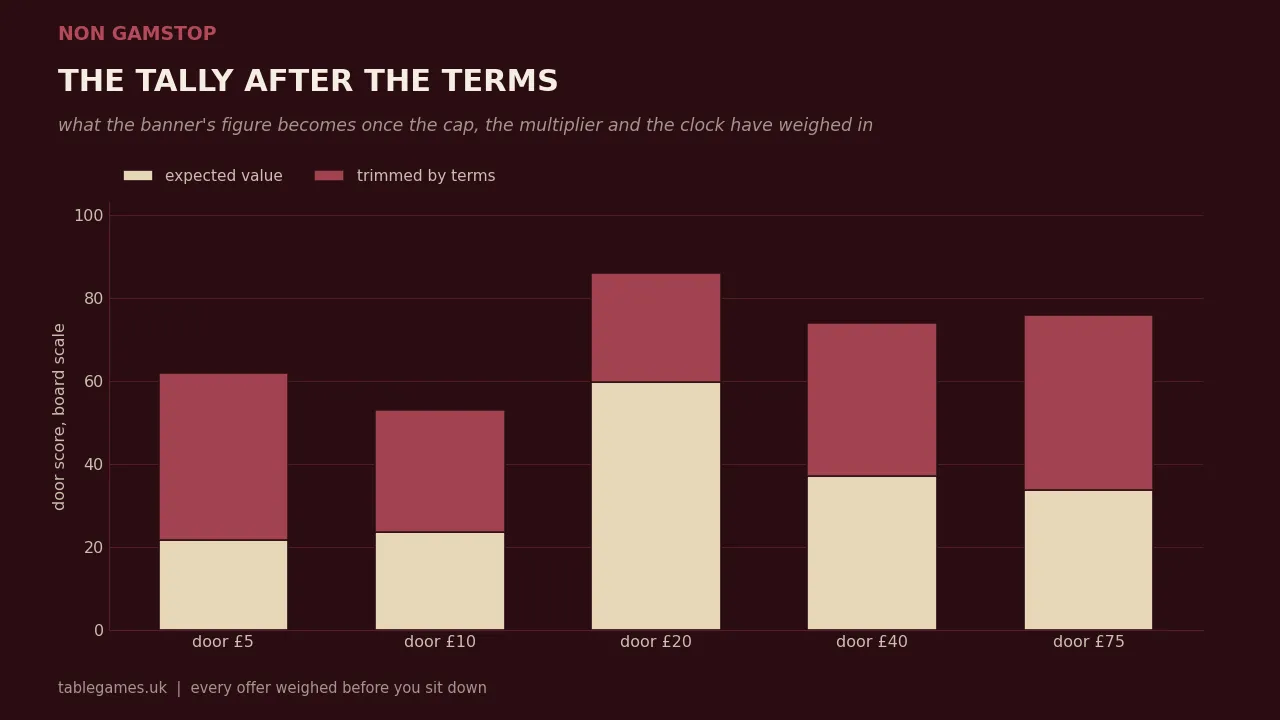
Batch size and stake size both multiply the receipt, but they do not multiply it equally. Twenty spins on a 25p box carry £5.00 of face value; one hundred at 10p carry £10..00; forty spins at 25p carry £10.00 again. The two levers trade against each other at the same face value, which is the only straight way to compare a small bundle at a big box against a big bundle at a small one.
Per spin, the stake is the whole lever: the expected return per go is the stake times the fraction, so 10p at 95 per cent expects 9.5p and 25p expects nearly 24p. Batch size never touches the per-spin line; it only counts the goes. A player who wants more per spin is asking about the box, a player who wants more goes is asking about the count, and the two questions price differently.
The terms bite differently on each lever. Conversion caps engage against totals, so bigger batches and bigger boxes both reach the ceiling sooner in absolute terms; wagering multiples scale with whatever lands, which scales with both levers at once. Expiry cares mainly about the clock rather than the size, though a larger conversion has more to lose to a short one. In the banner the levers look independent; in the terms they are tangled.
Run on one axis, the comparison settles quickly: price each offer per pound of face value - expected return over face - and let the count and the box fall where they may. A bundle at 95p per pound out-prices a bundle at 90p per pound regardless of which lever produced the difference. The card keeps one line and the whole class becomes comparable, which is the entire point of weighing levers instead of headlines.
A one-line weigh-in before claiming any spin bundle
The one line is expected return: spins, times the fixed stake, times the published fraction. Every other figure on the page either produces that line or trims it. The terms trim it at the conversion cap, at the wagering multiple, at the box set for clearance, and at the clocks. A bundle whose expected line survives the trims with something left is priced honestly; a bundle whose line dies at the cap was decided before the first spin was taken.
The line, chalked before the claim:
- Multiply the spin count by the fixed stake for the face value.
- Apply the machine's published long-run return for the expected figure.
- Read the multiple, the maximum stake and the conversion cap from the terms.
- Note both clocks: the one on the spins and the one on the winnings.
- Compare promotions by the pound of face value, never by the headline spin..
One line, four trims, two minutes of reading: that is the whole weigh-in, and it transfers unchanged to every bundle in the class. Offers that pass the line are worth the visit they ask for, which is a registration and nothing more. Offers that fail it were priced by the terms before the banner was ever drawn, and no count of spins will redraw them.
Frequently asked questions
What stake rides on a free spin?
Whatever the terms fix, and the player does not choose it. Current offers commonly run at 10p, with some bundles priced lower and some higher; the amount lives in the terms rather than on the promo page. The stake is the denominator for the whole offer: face value, expected return and the value of anything the wagering produces all scale from it, so it is read before anything else on the card.
How is the expected return counted?
Multiply the spin count by the fixed stake, then apply the machine's published long-run return. Forty spins at 10p are £4.00 of face value, and a machine publishing 95 per cent expects to return about £3.80 across the lengthy run. The figure is an average measured over thousands of spins, not a promise about a forty-spin batch, and individual bundles land on both sides of it without breaking the average.
What happens to spin winnings?
They arrive either as withdrawable cash or as bonus funds with a wagering multiple attached, and the difference is the largest single divider in the class. Bonus-funds winnings must be staked through at the terms' multiple, inside a maximum stake, against a clock, and beneath a conversion cap before they leave. Cash winnings are money on arrival. Which of the two applies is a terms figure, printed before the claim is made.
How long does the wagering take?
Long enough that the box and the clock deserve reading before the claim. At a £2 maximum stake, a 30x multiple on £3.80 of winnings books £114 of turnover, which is at least 57 rounds; at machine pace that is minutes, and at restricted pace it can stretch well past a week. The multiple scales the work and the expiry scales the time, and the two agree more rarely than the banner implies.
Where do the rules disagree?
Between the promo page and the terms, and the pattern repeats across the class: counts on the banner and stakes in the terms; a named machine on the page and an eligible-games list in the rules; silence on caps and clocks above, both printed below. The terms govern, because claiming the batch is acceptance of them, so the second rulebook is the one to read first and to keep a copy of.
Are spin winnings withdrawable immediately?
When the offer pays them as cash, yes: the batch converts and the balance is money. When the offer attaches a wagering multiple, no: the winnings clear on the terms' schedule, inside the stake box, under the clock and beneath the cap. The distinction is a terms figure the banner does not show it, and it is the opening line to chalk when pricing any bundle before taking it.