Independent Casinos Not on Gamstop: the Table, Weighed
Independence removes the rows a network prints for you. Weigh the protection gap first, then the felt, then the cashier, in that order.
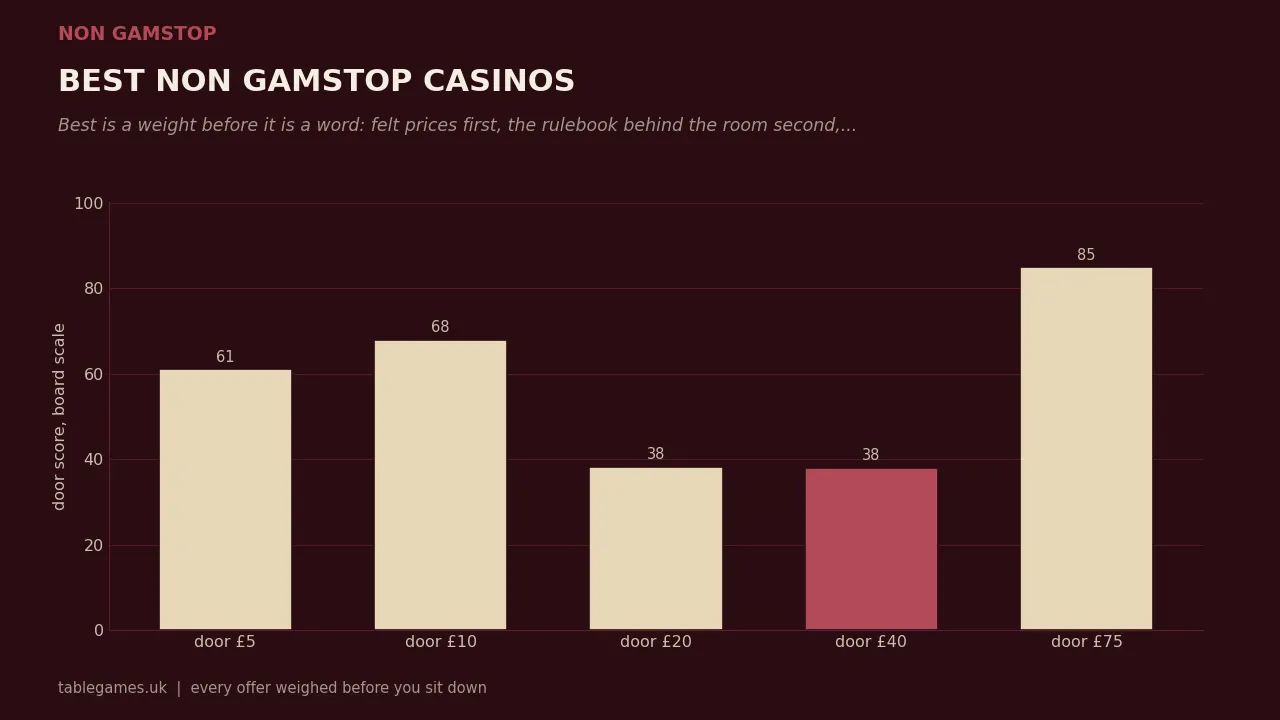
The table score
Four operators, weighed the way a croupier weighs a table: the entry price, the terms weight, the rails on offer, and how fast the cage pays. The scores are ours; the offers are quoted in the operator's own words.
Every card carries its table score out of 10 and four axis bars - licence, terms, payments and withdrawal. Offers move often - the operator's own page is always the current truth.

Welcome bonus €/£5,000 + 500 FS
Weigh the offer
Welcome pack €5,000 + 500 FS + €650 free bet
Weigh the offer
Casino welcome bonus 805% up to €6,400 + 280 FS
Weigh the offer
Welcome package 300% up to €/£1,000 + 150 FS
Weigh the offerCards appear in table-score order, the lower minimum deposit breaking ties. The bars visualise published figures, not a promise; nothing here is a recommendation to gamble, and the operator's own terms decide every claim.
What does independence actually remove from the table?
Independence describes ownership, not play. A room outside the big networks carries its own licence, writes its own terms and answers for them alone; the games on the felt are the same ones every lobby runs. What changes is the paper around the paper: no parent group prints a shared rulebook, no sister brand inherits a complaints desk, and no network standard sets the limits before the player arrives. The word independent is a fact about paperwork, and this page weighs paperwork before it weighs anything else.
A networked group prints its protections once and applies them across every brand: one exclusion list honoured group-wide, one set of limit tools, one disputes desk with somewhere to escalate. Strip the network away and the printing stops. An independent room writes its own lines, enforces them on its own systems and is judged by whatever authority issued its licence. Some write them well and some write them thin, and nothing on the banner says which. The reader supplies the check that the network used to supply.
The method on this page runs in the order the risks run. The protection gap comes first, because it is the one difference that cannot be fixed after a deposit: the national self-exclusion register stops at British licences, and a room outside the networks usually sits outside that line. The felt comes second, because the wheel and the shoe price the same wherever they stand. The cashier and the record-keeping come last, because they reward the prepared player in any room.
The protection gap, chalked in the room's own ink
The national self-exclusion register is drawn near British licences. Inside that border a single registration reaches every covered room, the shortest term on the register runs six months, and the duty to enforce it rests with the operator. Outside that border the registration has no force, and rooms licensed offshore are not covered. For a player who registered for serious reasons, that single line settles the page: the gap is not one factor among many but the deciding figure on the card.
What the room offers instead are its own tools: deposit ceilings set at the cashier, short-term cool-down switches, closures on request. Each is written, enforced and judged by the same operator, on the operator's timetable, with nobody outside checking the check. That is not a reason the tools fail; it is a reason they weigh less. A player building their own fence marks the difference on the card and adds the substitutes - bank-side blocks, a calendar, an honest look at the deposit history - rather than assuming the room supplies them. the wider non Gamstop shortlist, scored runs the same protection line across the broader board.
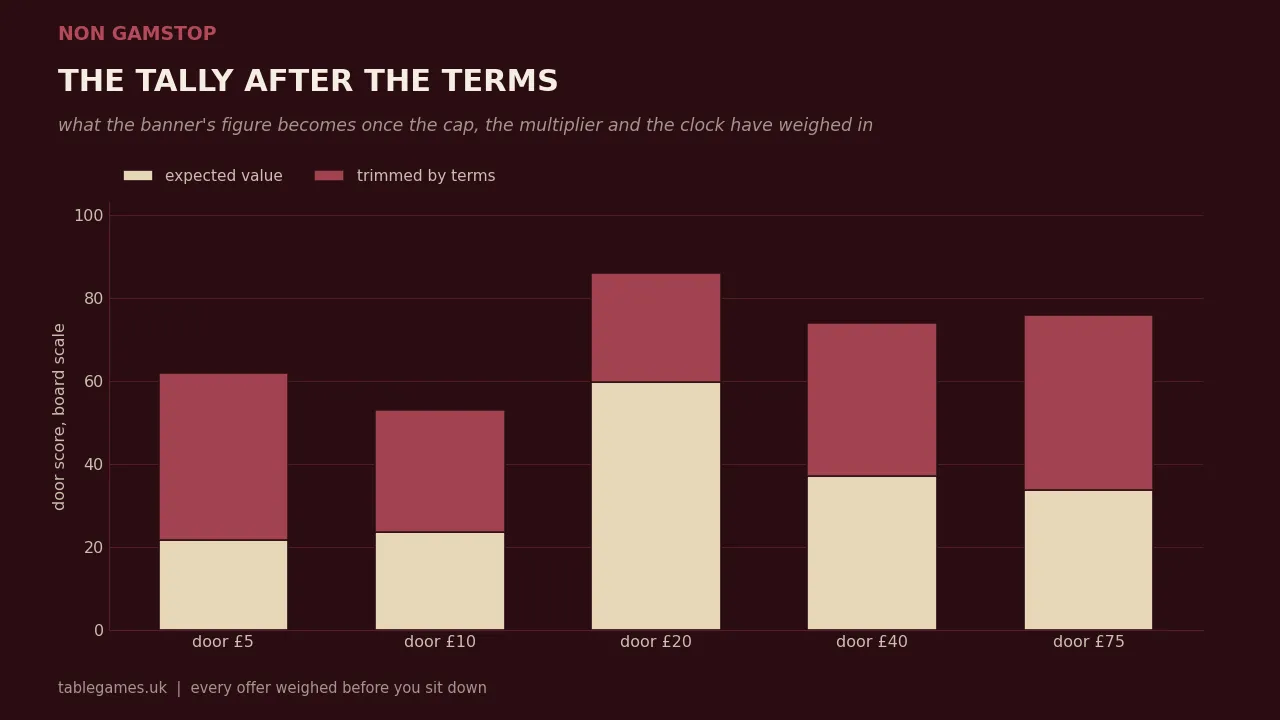
Weighed as a figure, the gap has a shape. A British registration is free, reaches every licensed room at once and binds the room against the player's worst week as well as the room's convenience. The self-written equivalent costs the player's own discipline every week, and its enforcement is the operator's goodwill. Neither figure is hidden; one is simply printed and the other handwritten. Pages that skip the difference are selling the handwritten version under the printed one's name, and the tally below keeps the two lines apart.
Independent casinos not on gamstop at a glance
- Entry price£20 typical
- Wagering60x on bonus
- Payout window2–4 working days
- Payments3 rails incl. e-wallet
The felt: prices that follow the wheel, not the network
The felt is where independence matters least, and the figures say so plainly. On a European wheel the house edge reads 2.70 per cent across every standard bet, with 37 pockets on the layout; add the second zero and the edge climbs to 5.26 across 38. A chip on a single figure pays 35 to 1 on either wheel, against true odds of 36 to 1, and the distance between those two prices is the extra pocket - not the licence above it.
The card games read the same way. Naturals priced at 3 to 2 keep the house edge near half a point with sound basic strategy, while 6 to 5 tables hand back roughly 1.4 points, a surcharge paid on every hand dealt. At baccarat, banker carries about 1.06 per cent against the player's 1.24 once the commission is taken; the tie box, paying 8 to 1, sits near 14.4 and marks a table's honesty better than any lobby text. Those fractions follow the layout, and independence does not touch them.
What varies room to room is configuration, not geography: how many decks, whether doubles are restricted, which side bets sit in their own priced panels. The rules panel on each table carries the printed figures, and reading it costs less than any claim on the lobby. The listed casinos change their lobbies and their rails; the wheel's arithmetic changes with the number of zeros and nothing else. Weigh the felt off the panel, wherever the room stands.
Who answers when a payout is questioned
The dispute ladder is where independence shows its weight. At any room the first rung is the support desk and the second is the formal complaints process; the third differs. A British licence obliges a room to offer independent arbitration, with published deadlines and a final file argued on paper. An offshore licence ends the ladder at the room's own regulator: the route exists, and it is slower, thinner and written in the regulator's terms rather than a British player's.
Before any dispute, the licence itself can be weighed: the footer names an operating company, and the regulator's public register should resolve that name to a live entry. the offshore register and the room it names walks the check line by line. Curaçao, the commonest stamp on independent rooms, has been moving from master licences to direct licences under its own gaming authority, and older paperwork may read either way during the changeover, so the register check is worth the two minutes it takes.
Whatever the ladder, the file moves with the claim. Balance screenshots with dates attached at the moments that decide anything, the terms exactly as accepted on day one, deposit references from the payment rail, and the transcript wherever a promise was made - assembled as it happens rather than rebuilt afterwards. A claim that lands with its evidence attached travels at the speed of the queue; a claim that asks the room to reconstruct history moves at the speed of goodwill. On an independent room, goodwill is the only employee on the third rung.
| Brand | Welcome offer | Wagering | Min dep. | Withdrawal | Payments | Licence | Table score | Terms |
|---|---|---|---|---|---|---|---|---|
| Virgin Games | Spend £10 play with £40–£70 (typical) | 2x–4x bingo / 40x pokiesbest | £5–£10best | 1–2 working days+2d | Visa · Mastercard · PayPal · Pay by mobile-1 rails | UKGC | 9.4 / 10 | Check the terms first |
| Bet365 | 100% up to £/€100 + spins (typical) | 35x typical+33x | £10+5 | 1–3 working days+3d | Visa · Mastercard · PayPal · Bank transfer-1 rails | UKGC | 7.8 / 10 | Check the terms first |
| Velobet | 100% up to €/£1,000 + spins (typical range) | 30x–45x by game+28x | €10 equivalent+5 | Instant–24h on cryptobest | Bitcoin · Litecoin · Visa · Bank transfer-1 rails | Offshore | 6.8 / 10 | Check the terms first |
| NetBet | Matched deposit up to £/€200 (typical) | 30x–40x by product+28x | £10+5 | Under 24h e-wallets+24d | Visa · Mastercard · Neteller · Pay by mobile-1 rails | UKGC | 6.6 / 10 | Check the terms first |
| Parimatch | Matched welcome up to €/£300 (typical) | 30x typical+28x | €20+15 | 1–3 working days+3d | Visa · Mastercard · Trustly · Bank transfer-1 rails | Offshore | 6.4 / 10 | Check the terms first |
| QuinnBet | 100% up to £/€100 + spins (typical) | 35x typical+33x | £10+5 | Under 24h e-wallets+24d | Visa · Mastercard · Skrill · Apple Pay-1 rails | UKGC | 6.3 / 10 | Check the terms first |
| Magic Red | 100% up to €200 + spins (typical range) | 40x typical+38x | €10–€20+5 | 2–5 working days+5d | Visa · Mastercard · Trustly · Bank transfer-1 rails | Offshore | 5.2 / 10 | Check the terms first |
| Mystake | 100% up to €/£1,000 + spins (typical range) | 35x typical+33x | €20 equivalent+15 | Under 24h on crypto+24d | USDT · BTC · ETH · TRX · Visabest | Offshore | 4.9 / 10 | Check the terms first |
| Boneenbet | 100% up to €/£1,000 + spins (typical range) | 35x typical+33x | €10 equivalent+5 | 24–48h (crypto fastest)+48d | Bitcoin · Litecoin · Visa · Bank transfer-1 rails | Offshore | 4.5 / 10 | Check the terms first |
| Rainbet | Crypto match up to 1 BTC equivalent (typical) | 40x typical+38x | €20 equivalent+15 | Under 24h on crypto+24d | BTC · ETH · USDT · MuchBetter-1 rails | Offshore | 4.1 / 10 | Check the terms first |
| NineWin | Matched deposit up to €/£500 + spins (typical) | 45x typical+43x | €10–€20+5 | 24–48h (crypto fastest)+48d | BTC · ETH · USDT · MuchBetter-1 rails | Offshore | 3.8 / 10 | Check the terms first |
| Fat Pirate | Crypto match up to 1 BTC equivalent (typical) | 45x typical+43x | €20 equivalent+15 | 24–48h (crypto fastest)+48d | Bitcoin · Litecoin · Visa · Bank transfer-1 rails | Offshore | 3.8 / 10 | Check the terms first |
Self-set limits: the tools the room writes for itself
Limits at an independent room are real tools with one author. Deposit ceilings, loss lines and session reminders commonly sit in the account menu, and setting them costs a minute; the difference from a British room is who enforces them. There the regulator audits the machinery; here the operator polices its own switches, and a request to raise a ceiling meets no outside voice. A player who wants the fence to stand sets it outside the room as well as inside it.
Two lines from the wider rulebook belong on the same card. Affordability checks: British rooms run them to national thresholds, while offshore rooms set their own, commonly at different levels, and none publish them; the honest assumption is that the ask arrives later and lighter. Credit cards: British rooms have barred them from gambling since April 2020; some offshore rooms still take them. That acceptance is a flag to read plainly - borrowing at the felt costs worse than any edge on it - not a perk to bank.
The substitutes are unglamorous and they work. A bank-side gambling block on the debit card covers every room at once and is enforced by an institution with no stake in the answer. A separate account or a prepaid rail caps the float a room can reach. A calendar note that reviews deposits monthly keeps the tally honest. None of it replaces the national register for a player who needs that register; for everyone else it is the handwritten version of the same fence.
Rails, caps and the receipts worth keeping
The cashier carries the room's own figures, and they are listed per room rather than set by any shared network. Minimum deposits, maximum withdrawals, payout windows and any fees sit in the cashier terms; windows commonly run one to five working days on the main rails, and the printed number is the one to argue from. A small, timed cash-out early in the relationship tests the whole chain - rail, clock, identity request - at a stake sized to be a lesson, not a loss.
Stake boxes differ in one direction worth noting. The statutory caps that landed on British online slots in September 2025 - five pounds and two pounds a spin by game type - apply to UK-licensed machines, and the tables were never included; offshore rooms set their own boxes on both floors. At the felt that changes little, since table limits were always the operator's and the table's. On the reels floor it is the clearest visible difference between the two boards, and the box sizes are printed on every game.
Receipts are the player's half of the relationship. Keep the bonus and cashier terms as printed at sign-up, every deposit reference, the confirmation of each withdrawal and balance screenshots with dates attached at the moments that decide anything. A folder built as it happens turns any later dispute into a filing exercise; a folder rebuilt after the fact turns it into an argument. Independence moves more of the room's paper onto the player's desk, and the desk should be ready for it.
The weigh card: independent rooms, checked in order
Six lines settle an independent room before the first stake, and they read top to bottom in the order the risks run: protection first, because it cannot be added later; paper second, because it names who answers; felt third, because it prices the play; limits fourth; the cashier fifth; the file sixth. The listed casinos on the board above score on the same six lines, and a room met elsewhere scores on them too.
The card for an independent room, read top to bottom:
- Set the exclusion line first: the national register stops at British licences, and this door sits beyond it.
- Resolve the licence against the regulator's public register, noting the company it names.
- Price the felt off each table's rules panel: zero count, natural prices, commissions and side-bet figures.
- Set deposit ceilings inside the room and a bank-side block outside it, so the fence has two posts.
- Run one small, timed cash-out in the first week and compare it against the window the cashier printed.
- Keep terms, references and dated balance screenshots in one folder, built as the relationship runs.
Independence is a trade, and the card prices the trade honestly. What the player gives up is printed: shared enforcement, a longer dispute ladder, a register that reaches other doors but not this one. What the player keeps is the same felt as everywhere else and a room that answers for its own lines. Score the six lines in order and the word independent stops being a slogan and becomes a figure - one that can be compared, room for room, on the same card.
Frequently asked questions
Are independent casinos safe to play at?
Safety is a tally, not a mood. The felt prices are as honest as any room's - the wheel and the shoe price the same everywhere. What differs is everything around the games: the register that cannot reach the door, the limits with a single author, a dispute ladder ending at the room's own regulator. A room that resolves on a public register, prints its figures and pays a test withdrawal on time scores as well as the paper allows; a room that hides a line fails the card.
Does Gamstop block independent casinos?
No. The register is drawn around British-licensed rooms, and an independent room is usually licensed offshore, so a registration made at home has no force at its door. The cool-down tools such rooms offer are their own writing, enforced on their own timetable and checked by nobody outside. For a visitor who signed the register for serious reasons, that boundary is the deciding line on this page, and it should be weighed before any figure on the felt or any window at the cashier.
Who regulates an independent casino?
The licence in the footer names the authority, and on independent rooms that is commonly an offshore regulator - Curaçao among them, where older master licences have been replaced by direct licences under the island's gaming authority. A complaint runs through the room's own process and ends with that authority, as the British arbitration schemes do not take offshore files. The practical check is short: take the company name and figure to the regulator's public register and check that the entry is live before the first deposit.
Do the games pay differently at independent casinos?
The tables pay by their layout, not by their landlord. A European wheel hands the house 2.70 per cent wherever it stands, banker at baccarat keeps its commission on either side of any border, and a single number pays 35 to 1 against true odds of 36 to 1 on both wheels. What drifts is configuration: deck counts, restricted doubles, side-bet prices and the shorter 6 to 5 natural. Each is printed on the table's rules panel, the only source worth reading on the subject.
Can I set deposit limits at an independent casino?
Usually, yes, and the tools commonly sit in the account menu: deposit ceilings, loss lines, session reminders and closures on request. The difference is enforcement. At a British room the regulator audits the machinery; at an independent room the operator writes, applies and judges its own switches, so a request to raise a ceiling meets no outside voice. The practical answer is to set limits on both sides of the cashier - inside the room, and at the bank, where a gambling block covers every room at once.
What records should I keep at an independent casino?
The folder that argues on the player's behalf: the bonus and cashier terms as printed at sign-up, every deposit reference, confirmation of each withdrawal, and balance screenshots, dated, at the moments that decide anything. Add the transcript wherever a promise was made. Assembled as the relationship runs, the folder turns a later disagreement into a filing exercise; rebuilt afterwards, it is an argument with no exhibits. Where the ladder's third rung is the operator's own regulator, the file is the player's strongest rung.