Slots Sign Up Bonus: the Match Against the Meter
A £10.00 match doubles the button to £20.00 and books £350.00 of staking at 35x. Weigh the counting rules, the cap and the clock first.
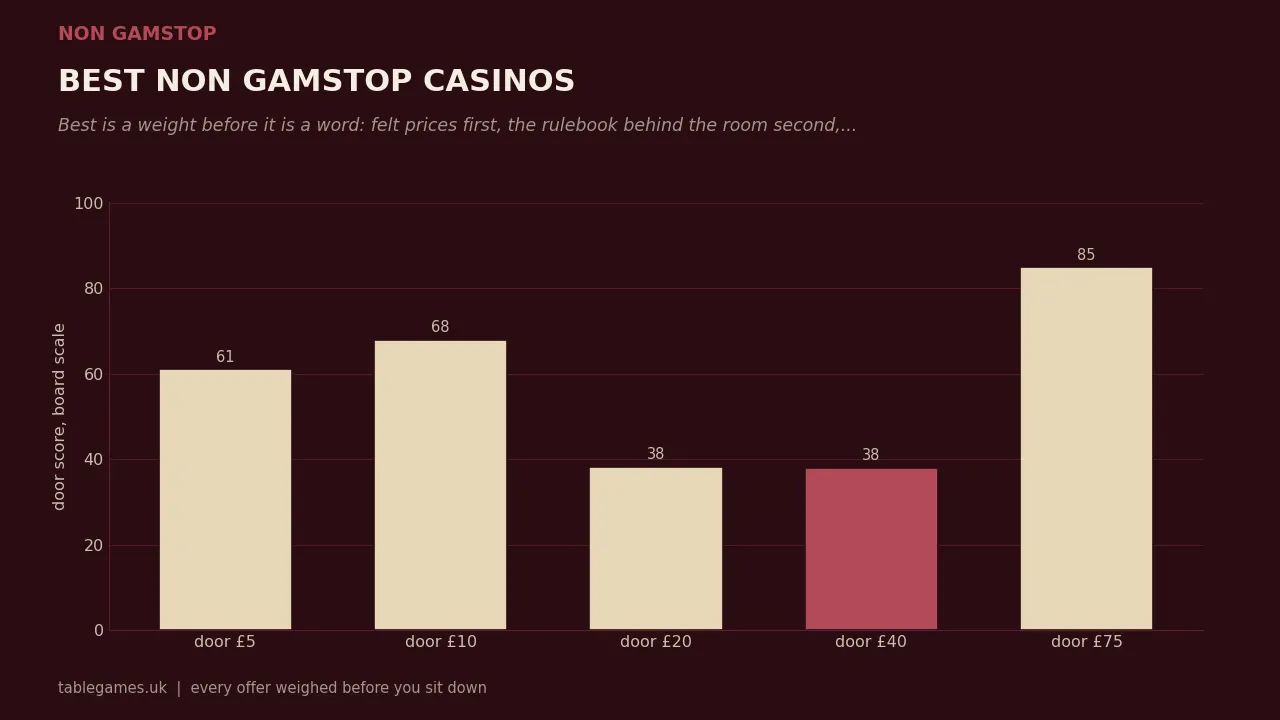
The table score
Four operators, weighed the way a croupier weighs a table: the entry price, the terms weight, the rails on offer, and how fast the cage pays. The scores are ours; the offers are quoted in the operator's own words.
Every card carries its table score out of 10 and four axis bars - licence, terms, payments and withdrawal. Offers move often - the operator's own page is always the current truth.

Welcome bonus €/£5,000 + 500 FS
Weigh the offer
Welcome pack €5,000 + 500 FS + €650 free bet
Weigh the offer
Casino welcome bonus 805% up to €6,400 + 280 FS
Weigh the offer
Welcome package 300% up to €/£1,000 + 150 FS
Weigh the offerCards appear in table-score order, the lower minimum deposit breaking ties. The bars visualise published figures, not a promise; nothing here is a recommendation to gamble, and the operator's own terms decide every claim.
What the match hands over, counted on arrival
The door offer is simple on its face: deposit £10.00, receive £10.00 of credit, and £20.00 sits at the button. The tally on arrival is honest; the price is behind it. Only half of that £20.00 is the room's money, and the half that is not arrives with rules attached: a staking multiple it must be turned through, counting rules that decide which games turn it, a ceiling on what it can pay, and a clock on how long it lasts. None of the four is printed at the same volume as the match. Read back to front, the four write the offer's review: the meter says how long, the counting rules say where, the ceiling says how much, the clock says by when.
Weighed as odds, the match is a stake the room places on the player, at paid odds. The true odds sit in the terms, and the gap between banner and terms is where every sign-up offer is actually priced. A player who reads only the banner accepts the paid odds; a player who reads the four rules knows the price of the second £10.00 before staking the first. Paid odds are not a trick; they are a price. The trick is only ever the banner declining to print them. That is the whole difference between taking an offer and being taken by the look of one.
This page keeps the weighing on the reels, because that is where the credit is meant to run: slots are the games the offers are built around, and the figures that follow - multiples, boxes, ceilings, clocks - are slot figures. The same match at a different counter weighs differently, and the general case is left to the welcome match at the main counter rather than doubled here. The reels are also where the counting rules pay in full, which is why the slot edition of the offer is the cleanest one to weigh.
The staking multiple behind the credit
The multiple is the load-bearing figure. Terms commonly quote it in the thirties for slot credit: £10.00 of credit at 35x books £350.00 of staking before the credit's business is done. At a 20p box that is 1,750 rounds; at the several hundred rounds an hour a machine-paced session runs, it is roughly three hours at the button. At a 50p box the same bill is 700 rounds and the credit is spent in an evening; the multiple does not speed up, the box does. The multiple converts the banner's pounds into the only currency that matters - rounds at a box.
The box then prices the evenings. A player at a 10p floor runs the same £350.00 across 3,500 rounds, which is a longer and cheaper ride; a player at a 50p box compresses it into 700 rounds. The credit does not care which; the meter counts stakes, not time. What the player cares about is the same trade as ever: decisions per pound, and the swings of 3,500 rounds are not the swings of 700. The bill is also the honest answer to the banner's question: not is the match big, but is the match turnable at the box the player actually uses.
Ground the weigh-in once and the habit transfers: any match, any multiple, the same two lines. Pounds of credit times the multiple gives the staking bill; the staking bill divided by the box gives the rounds. the four-column card, chalked in order slots a sign-up offer into the wider weighing of the games themselves, and the two cards read together price the whole door. Two lines, drawn once, price any door offer the reader will meet this year.
Slots sign up bonus at a glance
- Entry price£20 typical
- Wagering35x on winnings
- Payout window1–3 working days
- Payments4 rails incl. e-wallet
The counting rules: which games turn the meter
The meter is fussy about what turns it. A pound turned at the reels normally books as a full pound on the bill; a pound at the tables can book as a tenth, or nothing at all, and some live counters are left out of the arithmetic altogether. The direction is consistent across rooms even where the figures differ, which is why slot offers exist as a category: the reels are the room's preferred engine for clearing a match, and the terms steer the credit there. The direction matters more than the decimals: a player whose evenings are played at the reels clears at full rate, and a player whose evenings are not, does not.
The rules also prune within the reels. Individual titles can be held out of eligibility, and a batch of spins is usually pinned to one named game at a fixed box. The list sits in the offer's own terms - which title counts, at which box, from which deposit - and it is read in minutes. Pinned batches deserve the same read as free credit: the box is chosen, the game is chosen, and the winnings rules are the player's only moving part. An offer whose named game sits outside the player's own shortlist is priced accordingly, whatever the match size says.
Weighed properly, the counting rules are the offer's exchange rate. A full match on games that count in full is a very different animal from the same match on a meter that mostly ignores the player's preferred table. The banner shows the rate; the terms show the exchange; one of the two is countable, and it is not the banner. The counting rules are also the quietest line in the terms, which is exactly why they are read in full rather than glanced at.
Caps, clocks and the ceiling above the credit
Above the meter sit two limiters. The cap: winnings from credit are commonly stopped at a ceiling, often a multiple of the credit itself - a £50.00 ceiling on a £10.00 credit is the shape of it, though figures vary room to room and the printed one governs. The clock: credit and its winnings commonly expire inside weeks, with seven to thirty days the usual range. Between them they fence the second £10.00 in ways the banner never mentions. Both limiters are printed before the deposit is made; neither is hidden, and neither survives being unread.
The cap deserves the sharper pencil because it changes the payout odds of the whole offer. Credit at 35x that pays without a ceiling is a fair run at the reels; the same credit stopped at five times its size converts the tail of the distribution into the room's money, and the tail is where a high-swinging game pays. Weigh the cap against the shape of the game the credit must run through, and the pairing tells the player whether the offer rewards patience or trims it. A ceiling and a burst-shaped game are not automatically a bad pair; they are a pair that has to be read together, because the burst is where the ceiling does its work.
Rooms licensed offshore set these figures for themselves, so the cap, the clock and the counting rules are read at each room's own terms page rather than assumed from any house standard. The practical habit costs nothing: screenshot the three figures at the door, because the version read at sign-up is the version that prices the offer later. A screenshot costs nothing today and settles every later argument about which terms ran when the credit was claimed.
| Brand | Welcome offer | Wagering | Min dep. | Withdrawal | Payments | Licence | Table score | Terms |
|---|---|---|---|---|---|---|---|---|
| Dream Vegas | Matched deposit up to £/€200 (typical) | 35x typical+5x | £5–£10best | 1–3 working days+3d | Visa · Mastercard · Neteller · Pay by mobilebest | UKGC | 7.8 / 10 | Check the terms first |
| Admiral Casino | Matched deposit up to £/€200 (typical) | 30x–40x by productbest | £10+5 | 24h e-wallets, 2–5 days cards+5d | Visa · Mastercard · Neteller · Pay by mobilebest | UKGC | 7.7 / 10 | Check the terms first |
| Kinghills | Crypto match up to 1 BTC equivalent (typical) | 30x–45x by gamebest | €10 equivalent+5 | Instant–24h on cryptobest | Bitcoin · USDT · Visa · Mastercardbest | Offshore | 6.8 / 10 | Check the terms first |
| Velobet | 100% up to €/£1,000 + spins (typical range) | 30x–45x by gamebest | €10 equivalent+5 | Instant–24h on cryptobest | Bitcoin · Litecoin · Visa · Bank transferbest | Offshore | 6.8 / 10 | Check the terms first |
| Sky Vegas | 100% up to £/€100 + spins (typical) | 35x typical+5x | £10–£20+5 | Under 24h e-wallets+24d | Visa · PayPal · Paysafecard · Bank transferbest | UKGC | 6.3 / 10 | Check the terms first |
| LottoGo | Free bets / credits on first ticket (typical) | 40x on bonus funds+10x | £10+5 | 24–48h e-wallets+48d | Visa · Mastercard · Neteller · Pay by mobilebest | UKGC | 5.9 / 10 | Check the terms first |
| 10bet | 100% up to €200 + spins (typical range) | 40x typical+10x | €20+15 | 1–3 working days+3d | Visa · Mastercard · Skrill · Netellerbest | Offshore | 5.7 / 10 | Check the terms first |
| Magic Red | 100% up to €200 + spins (typical range) | 40x typical+10x | €10–€20+5 | 2–5 working days+5d | Visa · Mastercard · Trustly · Bank transferbest | Offshore | 5.2 / 10 | Check the terms first |
| Boneenbet | 100% up to €/£1,000 + spins (typical range) | 35x typical+5x | €10 equivalent+5 | 24–48h (crypto fastest)+48d | Bitcoin · Litecoin · Visa · Bank transferbest | Offshore | 4.5 / 10 | Check the terms first |
| Rolletto | 150% match + rakeback (typical range) | 35x typical+5x | €10 equivalent+5 | 24–48h (crypto fastest)+48d | Bitcoin · Litecoin · Visa · Bank transferbest | Offshore | 4.5 / 10 | Check the terms first |
| NineWin | Matched deposit up to €/£500 + spins (typical) | 45x typical+15x | €10–€20+5 | 24–48h (crypto fastest)+48d | BTC · ETH · USDT · MuchBetterbest | Offshore | 3.8 / 10 | Check the terms first |
| Fat Pirate | Crypto match up to 1 BTC equivalent (typical) | 45x typical+15x | €20 equivalent+15 | 24–48h (crypto fastest)+48d | Bitcoin · Litecoin · Visa · Bank transferbest | Offshore | 3.8 / 10 | Check the terms first |
Spin editions of the same door
The other common edition hands over rounds instead of credit: a batch of, say, 30 spins at a fixed 20p box. The face value is £6.00, and the fixed box is the difference that matters - the player does not choose the size, so the box column of the card is filled by the offer. A batch pinned to a wider-dial game values the same headline higher than one fixed to a narrow floor, before any other term is read. Priced near 96, £6.00 of rounds returns about £5.76 and the 24p difference is the price of the ride. The face count is printed beside the batch, which makes it the one figure on the door card the reader can verify without opening the terms.
Winnings-side rules then split the editions. Credit editions run winnings through the same meter; spin editions commonly attach their multiple to the winnings rather than the stake, sometimes with a ceiling waiting above. Both editions are weighed on one card: face against expected, meter behind, cap above, clock ticking. The edition changes where the figures sit; it does not change which figures count. The card does not care which edition the door runs; it cares that the figures are read where they actually sit.
A batch is therefore weighed exactly like credit, at the box it is pinned to. 30 rounds at 20p is £6.00 of staking the player did not size, at a game the player may not have shortlisted; anything it wins is real, and anything the terms trim from it was never really on the table. Fixed is not fatal; it is only fixed, and the read happens before the claim either way. The door hands over two editions and one arithmetic.
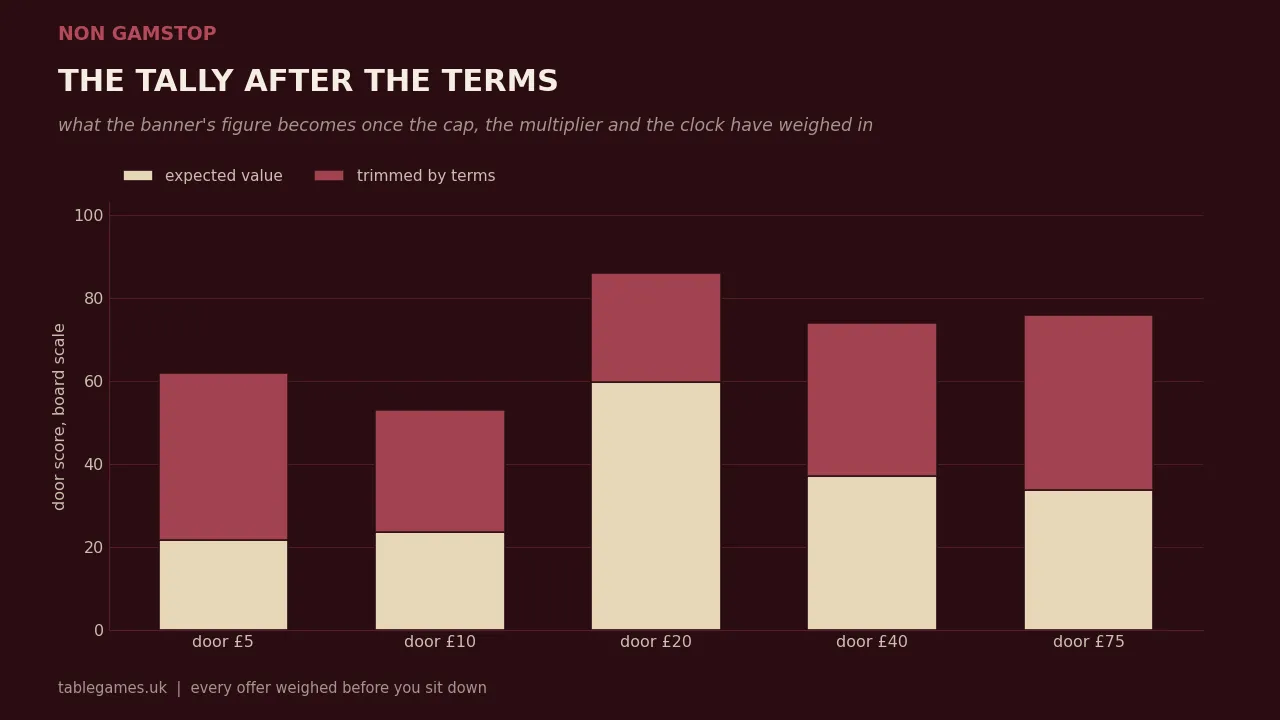
The match against the bare deposit
Strip the offer away and the comparison is clean. A bare £10.00 deposit is £10.00 of decisions at whatever box the player chooses, at whatever game the shortlist names, with no meter to clear and nothing hanging over it. The matched edition doubles the staking to £20.00 and then books £350.00 of obligations on the second half. The weigh is between flexibility and volume, and both are real prices; only one of them is advertised. The bare deposit also keeps every later decision free: no meter, no ceiling, no clock, and no terms to keep a copy of.
Which side wins depends on figures the player already holds: the box they play, the games they shortlist, the evenings they can give the meter. A player at a 10p floor on eligible titles turns the credit cheaply and keeps the whole benefit; a player at £1.00 on games the terms hold out books the same £350.00 in 350 rounds of reels they did not want. The offer pays the first player and charges the second, and the terms page names which one is which. The terms page settles the question in minutes, which is faster than either side of the argument usually runs.
The banner's volume also moves with the times: welcome economics on British licences tightened once the gaming duty reached 40 per cent in April 2026, so sizes and shapes of match are commonly leaner than the archive suggests. Hedged as context, it makes the same point as ever: the current terms, read this week, are the only ones that price this door. Sizes move, shapes move; the four figures on the card do not, which is why the card outlives any single banner.
slots sign up bonus: the counter card
The closing card chalks the door in four figures and one order: what lands, what it must be turned through, where it stops, and when it dies. Twenty pounds at the button is the banner; £350.00 at 35x is the bill; the ceiling and the clock are the fence; the counting rules are the exchange rate. Chalked so, the offer prices itself ahead of the first deposit move, and the banner returns to being one line among five.
The door card, chalked before the claim:
- Convert the match to a staking bill: credit times the multiple, at the box actually played.
- Read the counting rules; the reels usually count in full, the tables rarely do.
- Find the ceiling on winnings and weigh it against the game's swing.
- Check the clock on the credit and plan the evenings the meter needs.
- Compare the matched door with a bare deposit at the same box before choosing.
- Keep a copy of the terms read at sign-up; that version prices the offer.
A sign-up match is no gift and no trap; it is a price with four moving parts. Weighed in those parts - bill, exchange, ceiling, clock - it becomes what every other line on the site becomes: a figure a reader can accept or walk past, with the walking still free. Four parts, one habit, and the habit is the part that transfers to the next door the reader meets.
Frequently asked questions
What is a slots sign up bonus, in one line?
A stake the room places on the player: credit or rounds handed over at the door, wrapped in a staking multiple, counting rules, a ceiling and a clock. The banner prices the first of those four and leaves the rest in the terms, which is where the offer is actually weighed.
How much staking does a £10.00 match demand?
At 35x, £350.00 - and the figure moves with the multiple. At a 20p box that is 1,750 rounds; at a 10p floor, 3,500. The multiple converts the banner into a staking bill, and the box converts the bill into evenings. Both lines are chalked before the deposit, not after.
Why do the offers steer play to the reels?
Because the counting rules pay the reels in full and the tables at a tenth, where they pay at all. The meter is the offer's engine, and slots are its preferred fuel. An offer built on the reels is an offer the room has priced to clear; the terms say so plainly to anyone who reads them.
What does a ceiling do to the offer's value?
It trims the top of the distribution. A £50.00 ceiling on a £10.00 credit converts the biggest outcomes into the room's money, which matters most on games that pay in bursts. The fairer comparison is ceiling against the shape of the named game: steady payers feel a cap less than high-swinging ones do.
Are spin batches better than credit?
Neither, on the arithmetic - they are the same card with the figures moved. A batch pins the box and the game; credit leaves the box to the player but runs winnings through the meter. Weigh face against expected, meter behind, cap above, clock ticking, and the better edition is whichever fits the shortlist.
Can the credit be withdrawn straight away?
No, and the meter is the reason. Credit exists to be turned through the staking bill; withdrawing it unturned forfeits it, and the terms say so. Even winnings from credit can carry their own multiple before they leave. The tally that actually leaves the door is the one that survives the bill, the ceiling and the clock.